9 Best Food Dehydrators for a Small Business (November 2026)
The best food dehydrators for small business batches include the Magic Mill Pro Food Dehydrator Machine for repeatable multi-tray batches, the Magic Mill Premium Food Dehydrator Machine for larger runs, and the Magic Mill Food Dehydrator Machine for modest production.
On this page (7 sections)
- How we chose food dehydrators for small business batches
- What matters most in a food dehydrator for a small business?
- Which dehydrators suit different business workflows?
- How can you plan batch production around a dehydrator?
- How should a small business compare dehydrator capacity?
- What else should a small business check before buying?
- Which food dehydrator should a small business choose?
The best food dehydrator for a small business is one that matches your batch size, product mix and daily workflow. For larger runs, compare the 10-tray Magic Mill models; for smaller work areas, consider five-tray or seven-tray machines.
Tray count is only one part of capacity. Drying space, tray dimensions, temperature controls, airflow, timer length and cleanup all affect how well a dehydrator fits a repeatable production routine.
Use this guide to compare countertop and cabinet-style options by their stated features. Before buying for commercial use, check the manufacturer’s operating instructions and confirm the unit suits your intended workload.
Our picks at a glance
-
1
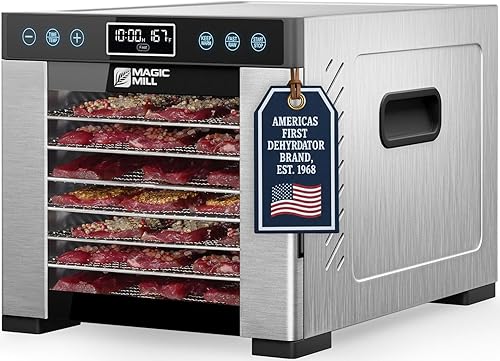 Best for repeatable multi-tray batches
Magic Mill Pro Food Dehydrator Machine
9.4/10 our score
See it on Amazon -
2

-
3
- 4
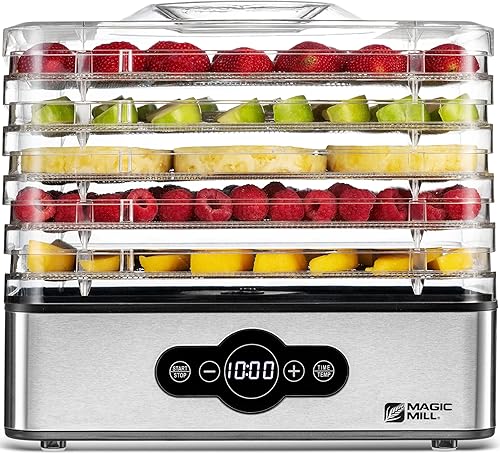
 Best for compact stainless steel setupCheck it
- 5
 Best for expandable small batchesCheck it
- 6
 Check it
Magic Mill Pro Food Dehydrator Machine
Best for 10-tray capacity - 7
 Check it
PSIIDAN Food Dehydrator Machine
Best for eight-tray batches - 8
 Check it
Hamilton Beach Digital Food Dehydrator for Fruit
Best for simple starter batches - 9
 Check it
Konfintos Small Food Dehydrator for Jerky
Best for very small batches
How we chose food dehydrators for small business batches
We compared stated tray count, drying area, controls, airflow, timer and cleanup features to find machines that fit different small-business workflows. Our score weighs specs and features against the needs of someone producing repeated batches.
A business making small runs of herbs has different needs from one preparing several trays of fruit or jerky at a time. More trays may reduce the number of cycles, while a compact unit may make better use of limited counter space.
Product details do not guarantee commercial certification or a suitable daily duty cycle. Check the brand’s guidance for your planned use, and account for prep time, drying time, cooling, packaging and cleaning when estimating output.
What matters most in a food dehydrator for a small business?
For a small business, usable capacity and workflow fit matter more than the highest tray count alone. Consider how much food fits on each tray, how often you need to rotate or check batches, and whether the controls fit your recipes.
A larger unit can help when a single batch needs more room, but it also takes more counter space. A small machine can be useful for testing products or handling specialty runs, though it may require more cycles as demand grows.
Think through the full process before choosing: washing and slicing, loading trays, drying, cooling, packing and cleaning. To compare cabinet designs and larger capacity options, see our guide to the best commercial food dehydrators.
How many trays does a small business need?
The right tray count depends on the amount of food you process in one cycle and how often you can run the dehydrator. Five trays may suit small or specialty batches, while 7 to 10 trays provide more rack space for larger runs.
Tray count alone does not show the total drying area. Compare tray dimensions and usable space as well, especially if you portion products into a consistent pack size.
Should a small business choose a stackable or cabinet dehydrator?
A stackable dehydrator can suit a compact workspace and modest batches. A cabinet-style model with a rear fan can offer more trays and airflow features for larger or repeated runs.
Check the machine’s footprint, clearance needs and loading arrangement against your workspace. For additional selection criteria, read what to look for in a food dehydrator.
Which dehydrators suit different business workflows?
The best match depends on whether you value large batch capacity, a smaller footprint or room to expand later. These picks are ordered by score, with each one aimed at a distinct production need.
| Product | Best for | Trays | Wattage | Temperature | Our score |
|---|---|---|---|---|---|
| Magic Mill Pro Food Dehydrator Machine | repeatable multi-tray batches | 7 stainless steel | 600W | 95–176°F | 9.4 |
| Magic Mill Premium Food Dehydrator Machine | larger runs | 10 extra-large | 700W | 95–167°F | 9.6 |
| Magic Mill Food Dehydrator Machine | modest production | 5 stainless steel | 240W | Up to 167°F | 9.5 |
| Cosori Food Dehydrator | compact stainless steel setup | 5 stainless steel | 95–176°F | 9.7 | |
| Cosori Food Dehydrator | expandable small batches | 5, expandable to 7 | 350W | 95–165°F | 9.5 |
| Magic Mill Pro Food Dehydrator Machine | 10-tray capacity | 10 stainless steel | 600W | 95–176°F | 9.3 |
| PSIIDAN Food Dehydrator Machine | eight-tray batches | 8 stainless steel | 650W | Up to 167°F | 9.2 |
| Hamilton Beach Digital Food Dehydrator for Fruit | simple starter batches | 5 stackable | 100–160°F | 9.7 | |
| Konfintos Small Food Dehydrator for Jerky | very small batches | 5 height-adjustable | 250W | 95–158°F | 9.3 |
Magic Mill Pro: best for repeatable multi-tray batches
Magic Mill Pro Food Dehydrator Machine: Best for repeatable multi-tray batches
- 7 stainless steel trays
- 600W rear fan
- 95–176°F control in 1° increments
- 48-hour timer and auto shutoff
Seven stainless trays and a rear fan suit repeated batches where consistent tray airflow and precise temperature adjustments matter.
Pros
- 7 stainless steel trays
- Rear fan and rear heat
- Keep Warm mode for up to 24 hours
Cons
- Fewer trays than the 10-tray picks
- Confirm that its listed dimensions fit your work area
The seven-tray Magic Mill Pro is a practical fit for a business that wants a middle ground between five-tray units and larger 10-tray cabinets. Its 600W rear fan and rear heat are designed to move air across the trays, and the maker says tray rotation is not needed.
The digital controls adjust temperature from 95°F to 176°F in 1°F steps. A timer runs up to 48 hours in 30-minute steps, followed by automatic shutoff.
A Keep Warm mode holds food at 95°F for up to 24 hours after a cycle. The stainless steel interior, exterior and trays may also suit a workflow where a metal build is preferred.
This is the strongest fit here for repeat batches that benefit from detailed temperature settings. Check the work area against its 15.5 x 11.3 x 10.8 in dimensions before choosing it.
Magic Mill Premium: best for larger runs
Magic Mill Premium Food Dehydrator Machine: Best for larger runs
- 10 extra-large stainless steel trays
- 700W
- Rear-mounted fan
- 48-hour timer
Ten extra-large trays and 700W of power make this a strong fit when a small business needs more room per cycle.
Pros
- 10 extra-large stainless steel trays
- Rear fan for even drying
- Keep Warm function
Cons
- Larger footprint than compact countertop units
- Maximum temperature is lower than some picks here
This 10-tray Magic Mill Premium offers the most tray space among these picks. Its extra-large stainless steel trays and 700W power make it a candidate for businesses processing more food per cycle.
The rear-mounted fan is designed for even drying across the trays, with a transparent door for checking progress. Temperature control runs from 95°F to 167°F, and the digital timer can be set for up to 48 hours.
It also has a Keep Warm function that maintains serving temperature for another 24 hours, according to the product details. The trays and liners are described as dishwasher safe.
Choose this model when tray count and extra-large racks match your batch plan. Its 18 x 13 x 14 in dimensions need more room than the compact five-tray options.
Magic Mill five-tray: best for modest production
Magic Mill Food Dehydrator Machine: Best for modest production
- 5 stackable stainless steel trays
- 240W
- Adjustable tray height
- Timer up to 48 hours
Five stackable trays offer a smaller starting point for modest batches, with adjustable space for thicker ingredients.
Pros
- Five stainless steel trays
- Tray height adjusts for thicker foods
- Timer runs up to 48 hours
Cons
- Less tray capacity than larger models
- The supplied temperature range is inconsistent
The five-tray Magic Mill is a smaller option for a business with modest output or a limited work area. Its trays are stainless steel, and their height can be adjusted from the standard 0.6 in spacing to 1.1 in for thicker ingredients.
The controls offer a timer up to 48 hours, and the product details describe temperature adjustment from 95°F to 167°F. The specification data also gives a 158°F temperature value, so confirm the current operating range with Magic Mill before relying on a particular setting.
At 240W, this machine is positioned as a compact dryer. Its five trays mean it may need more cycles than a larger cabinet for the same volume.
Cosori stainless steel: best for a compact setup
Cosori Food Dehydrator: Best for compact stainless steel setup
- 5 stainless steel trays
- 3.1 sq ft drying space
- 480W
- Rear fan and 48-hour timer
A compact stainless steel body and 3.1 sq ft of drying space suit a small operation with limited counter room.
Pros
- Stainless steel trays
- Rear fan promotes even airflow
- Four presets
Cons
- Only five trays
- Less total capacity than the larger cabinet models
The five-tray Cosori suits a small operation that wants stainless steel trays and a compact countertop body. It provides 3.1 sq ft of drying space in dimensions of 13.9 x 11.3 x 8.9 in.
A rear fan promotes airflow through the trays, and the temperature range is 95°F to 176°F. Four presets cover jerky, fruit, vegetables and yogurt, and the timer can run from 30 minutes to 48 hours.
The included accessories are a mesh screen and fruit roll sheet, which can support different product formats. Its compact footprint is useful where space is tight, though five trays may limit output for larger orders.
Cosori expandable: best for small batches that may grow
Cosori Food Dehydrator: Best for expandable small batches
- 5 BPA-free trays
- Expandable to 7 trays
- 350W
- 95–165°F control
This five-tray unit can expand to seven trays, giving a small business room to increase batch size without changing the whole setup.
Pros
- Can expand to 7 trays
- Adjustable tray height
- 48-hour timer
Cons
- Expansion trays are separate accessories
- Lower maximum temperature than some alternatives
This Cosori starts with five BPA-free trays and can expand to seven with separate trays. That gives a small business a way to increase rack count if demand grows, without moving immediately to a larger cabinet.
Temperature adjusts from 95°F to 165°F in 1°F steps, and the timer runs up to 48 hours in 30-minute increments. The tray height can also be adjusted for thicker ingredients or easier storage.
Its 350W design and 12.2 in round footprint suit smaller batches. Remember to include the cost and availability of the optional trays in your expansion plan.
Magic Mill Pro 10-tray: best for maximum tray count
Magic Mill Pro Food Dehydrator Machine: Best for 10-tray capacity
- 10 stainless steel trays
- 600W
- Rear-mounted fan
- Keep Warm function
Ten stainless steel trays and a rear-mounted fan suit larger production runs where tray count is a priority.
Pros
- 10 stainless steel trays
- Rear fan for heat distribution
- Automatic shutoff
Cons
- Taller than the 7-tray Magic Mill Pro
- Keep Warm temperature and duration aren't specified
This Magic Mill Pro has 10 stainless steel trays and a rear-mounted fan, making it a candidate for businesses that want more rack positions in one cabinet. Its stated dimensions are 15.5 x 11.5 x 14 in.
The controls include a digital timer, adjustable temperature and automatic shutoff. The temperature range is 95°F to 176°F, and the unit has a Keep Warm function.
The product details do not specify the Keep Warm temperature or duration, so factor that into your workflow only after checking the manual. With 10 trays, this model may suit larger batches, but confirm the cabinet fits your available counter and clearance.
PSIIDAN: best for eight-tray batches
PSIIDAN Food Dehydrator Machine: Best for eight-tray batches
- 8 stainless steel trays
- 650W
- Temperature up to 167°F
- 48-hour timer
Eight trays give this model a middle ground between five-tray countertop designs and larger 10-tray cabinets.
Pros
- 8 stainless steel trays
- 650W motor
- Mesh and drip trays included
Cons
- Temperature range is not fully specified
- Confirm dimensions and operating details for your workspace
The PSIIDAN offers eight stainless steel trays, placing it between the five-tray units and 10-tray cabinets. Its 650W motor and stated temperature control up to 167°F give it a useful feature mix for varied batch work.
The timer can run up to 48 hours, and the included accessories include a mesh tray and drip tray. The maker also describes an interior light for checking food without opening the door.
The full temperature range and cabinet dimensions are not included in the product details here. Confirm both before placing it in a production workflow, especially if you need a specific setting or have fixed counter space.
Hamilton Beach: best for starter batches with more stated drying area
Hamilton Beach Digital Food Dehydrator for Fruit: Best for simple starter batches
- 5 stackable trays
- Up to 4.2 sq ft drying space
- 500W
- Digital timer and auto shutoff
Its stated 4.2 sq ft of drying space gives a five-tray design room for small batches, with a digital timer and automatic shutoff.
Pros
- Up to 4.2 sq ft drying space
- No tray rotation needed
- Dishwasher-safe trays and lid
Cons
- Five trays limit batch count
- Temperature tops out at 160°F
The Hamilton Beach has five stackable trays and up to 4.2 sq ft of drying space, which gives it a notable stated area for a five-tray design. It uses a 500W base-mounted heater and quiet fan, with airflow intended to dry evenly without tray rotation.
Temperature adjusts from 100°F to 160°F, and the digital timer runs from 1 to 48 hours before automatic shutoff. A clear lid helps you monitor the batch, while a mesh screen and fruit leather sheet support herbs and fruit leather.
The trays and lid can go in a dishwasher, but avoid heated drying or sanitize modes. Consider it for small starter runs where its five-tray capacity is enough.
Konfintos: best for very small batches
Konfintos Small Food Dehydrator for Jerky: Best for very small batches
- 5 height-adjustable trays
- 250W
- 95–158°F control
- Timer up to 72 hours
A compact five-tray design can suit a business testing a narrow range of products in small runs before scaling up.
Pros
- Compact dimensions
- Height-adjustable trays
- Timer up to 72 hours
Cons
- Small batch capacity
- Maximum temperature is 158°F
The compact Konfintos is best suited to a business testing small runs or drying a limited amount of specialty product. Its five height-adjustable trays, 250W heating system and dimensions of 7.28 x 11.81 x 7.87 in make it the smallest footprint among these picks.
Temperature adjusts from 95°F to 158°F, and the timer can run up to 72 hours. The transparent trays let you check progress without opening the unit, and the trays are dishwasher safe below 158°F.
Its compact size is convenient, but the five trays and lower maximum temperature may limit the products and batch sizes it can handle. Check that its capacity matches your planned output before treating it as a production machine.
How can you plan batch production around a dehydrator?
Plan production by working backward from the finished quantity you need, then estimate how many cycles and trays that requires. A dehydrator’s tray count does not guarantee a set output because ingredients, slice thickness and moisture levels affect drying time.
Keep a written record of the food type, slice thickness, tray arrangement, temperature, cycle duration and finished yield. This helps you repeat a recipe and spot when a batch needs a different setup.
Leave time for cooling and packing after drying, and include cleaning between products. A unit that handles your largest batch may still be a poor fit if loading and cleanup disrupt other work.
How should a small business compare dehydrator capacity?
Compare total drying area, tray dimensions and usable spacing alongside the number of trays. The Hamilton Beach, for example, states up to 4.2 sq ft of drying space across five trays, while the stainless steel Cosori states 3.1 sq ft across five trays.
Those figures can help compare designs, but they do not show how much finished product you will get. Your yield depends on what you dry and how you prepare it, so start with a small recipe batch and record the results.
If you're still estimating the rack space your workflow needs, use What Size Food Dehydrator Do I Need? What It Comes Down To.
For brand-specific options, see our BenchFoods dehydrator reviews.
What else should a small business check before buying?
Check temperature range, timer length, airflow design and cleaning instructions against the foods you plan to make. These features affect recipe control and the time needed between batches.
Also confirm dimensions, tray availability and the maker’s guidance for repeated use. Product details here do not confirm a commercial duty cycle or business certification, so ask the manufacturer if daily production is part of your plan.
If a product uses a lower maximum temperature than your process requires, it may not fit even if it has many trays. Make sure the machine supports your planned recipe and food safety process before you buy.
Which food dehydrator should a small business choose?
Choose the 10-tray Magic Mill Premium when larger rack capacity is the main need, or the seven-tray Magic Mill Pro when you want precise temperature adjustments and a middle-size batch setup. For compact work areas, compare the five-tray Cosori models and Hamilton Beach by drying area, material and controls.
If you're still testing demand, begin with a batch size you can prepare and package comfortably. Move to a larger cabinet when your recorded workflow shows that extra tray space would reduce the number of cycles you need.
Our top 3 picks at a glance
-
1
Best for repeatable multi-tray batches
Magic Mill Pro Food Dehydrator Machine
9.4/10 our score
See it on Amazon -
2
-
3


