9 Best Food Dehydrators for Herbs (October 2026)
The best food dehydrators for herbs include the Hamilton Beach Digital Food Dehydrator for Fruit for an herb starter setup, the Cosori Food Dehydrator for large herb batches, and the Magic Mill Food Dehydrator Machine for adjustable tray spacing.
On this page (5 sections)
The best food dehydrator for herbs for most kitchens is the Hamilton Beach Digital Food Dehydrator, which includes a mesh screen and adjustable temperature control. Choose the Cosori for a larger batch, or a Magic Mill Pro when you want several trays and mesh screens.
Herbs need a little more attention than thick pieces of fruit. Small leaves can slip through open trays, and delicate herbs call for a low drying temperature and regular checks.
For similar low-temperature guidance on mushrooms, see mushroom dehydrator picks.
This roundup compares controls, tray capacity and herb-friendly accessories. We checked the available product details, but we did not test these machines.
Our picks at a glance
-
1
 Best for an herb starter setup
Hamilton Beach Digital Food Dehydrator for Fruit
9.7/10 our score
See it on Amazon -
2

-
3
 Best for adjustable tray spacing
Magic Mill Food Dehydrator Machine
9.5/10 our score
See it on Amazon
- 4
 Best for a compact expandable setupCheck it
- 5
 Check it
Magic Mill Pro Food Dehydrator Machine
Best for low-temperature control and capacity - 6
 Check it
Septree Food Dehydrators Machine with 12 Stainless
Best for very large batches - 7
 Best for a short, simple herb cycleCheck it
- 8
 Check it
Magic Mill Pro Food Dehydrator Machine
Best for herbs plus frequent batch drying - 9
 Check it
PSIIDAN Food Dehydrator Machine
Best for herbs and varied foods
Which food dehydrator for herbs is the best fit?
The best fit depends on how much you dry and whether you need a mesh screen for loose leaves. For most home cooks, the Hamilton Beach offers a useful mix of temperature control, a timer and an included herb screen.
Hamilton Beach Digital Food Dehydrator for Fruit: Best for an herb starter setup
- 5 stackable trays
- Mesh screen for herbs
- Temperature adjusts from 100–160°F
- Digital timer up to 48 hours
The included mesh screen gives small herb leaves a dedicated surface, while adjustable temperature and a digital timer make it easier to set a drying cycle.
Pros
- Mesh screen included for herbs
- Temperature control from 100–160°F
- Automatic shutoff when timer ends
Cons
- 5 trays offer less space than the larger multi-tray picks
- Mesh screen needs hand washing
The Hamilton Beach is a practical starting point if you dry herbs now and then but also want to make fruit or vegetable snacks. Its mesh screen is included for herbs, so you have a surface designed for smaller pieces.
The temperature adjusts from 100°F to 160°F, and the digital timer runs from 1 to 48 hours before automatic shutoff. Five stackable trays give you up to 4.2 sq ft of drying space.
A clear vented lid lets you check the drying process without removing the lid. The trays and lid can go in the dishwasher, but the mesh screen needs hand washing.
Choose this model when the included screen matters more than having the largest tray area.
Cosori Food Dehydrator: Best for large herb batches
- 6 stainless steel trays
- 6.5 sq ft of drying space
- Temperature adjusts from 95–165°F
- Mesh screen included
Six trays and a mesh screen suit people drying herbs alongside other foods. Its digital controls adjust temperature by degree and timer up to 48 hours.
Pros
- 6.5 sq ft of drying space
- Mesh screen included
- Temperature adjusts in 1°F steps
Cons
- Larger footprint than compact tray models
- The available space may be more than occasional herb drying needs
The Cosori suits bigger herb harvests or cooks who want to dry herbs alongside other foods. It has 6 stainless steel trays and 6.5 sq ft of drying space, plus an included mesh screen.
The digital control sets temperature from 95°F to 165°F in 1°F steps and runs for up to 48 hours. Those settings provide a wider low end than the Hamilton Beach, while six trays make room for a larger batch.
The six trays are dishwasher safe. This machine takes more room than a compact stackable model, so measure your counter and storage spot before choosing it.
See our best small dehydrator for herbs picks if you have limited space.
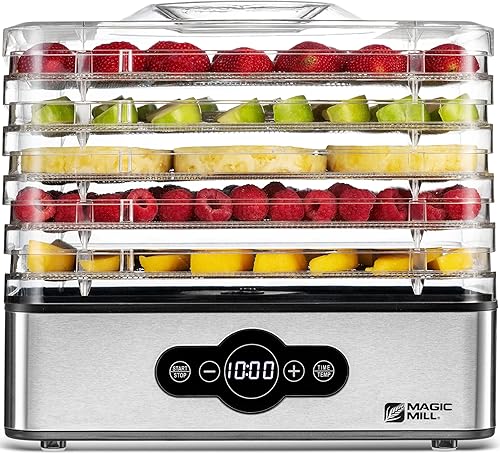
Magic Mill Food Dehydrator Machine: Best for adjustable tray spacing
- 5 stainless steel trays
- Temperature adjusts from 95–167°F
- Tray height adjusts from 0.6 to 1.1 in
- Digital timer up to 48 hours
Adjustable tray height helps make room for different foods, and the digital controls let you choose a temperature and drying time. The five-tray layout suits modest batches.
Pros
- Adjustable tray height
- Temperature control from 95–167°F
- Trays are dishwasher safe
Cons
- No herb mesh screen is specified
- 5 trays provide less space than the larger cabinet models
The Magic Mill has five stainless steel trays with adjustable height, which gives you flexibility when arranging foods of different thicknesses. Each tray's standard spacing is 0.6 in and can be raised to 1.1 in.
Its digital control adjusts from 95°F to 167°F and supports a timer up to 48 hours. That combination can suit someone who dries herbs and occasionally uses the same machine for thicker ingredients.
The trays can be washed with soapy water or in a dishwasher. No herb mesh screen is specified for this model, so consider how you will contain small leaves before buying.
If low temperature settings are your main concern, compare our best low temp food dehydrator guide.
Cosori Food Dehydrator: Best for a compact expandable setup
- 5 BPA-free trays
- Temperature adjusts from 95–165°F
- Expandable to 7 trays
- Adjustable tray height
This round model offers five trays at the start, with the option to add two more. Adjustable temperature and tray height add flexibility for herbs and other foods.
Pros
- Expandable to 7 trays
- Temperature adjusts in 1°F steps
- Tray height adjusts
Cons
- Additional trays are not included
- No mesh screen is specified
This Cosori is a round, expandable option for a home that may need more tray space later. It starts with five BPA-free trays and can expand to seven with additional trays.
Temperature adjusts from 95°F to 165°F in 1°F steps, with a timer that runs up to 48 hours. The tray height can also be adjusted, which helps when you need a little more room between layers.
The added trays are optional, so consider the starting capacity when comparing it with models that include more trays. No mesh screen is specified here.
This makes it a better fit for people who value expandable capacity than for those who want an herb screen in the box.
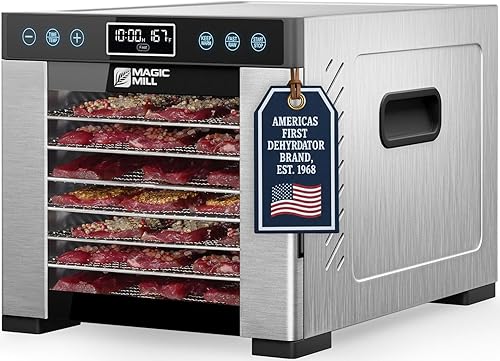
Magic Mill Pro Food Dehydrator Machine: Best for low-temperature control and capacity
- 7 stainless steel trays
- Temperature adjusts from 95–176°F
- 2 mesh screens included
- Rear fan
Two mesh screens offer surfaces for herbs and other small items, while seven trays allow larger batches. The temperature control starts at 95°F.
Pros
- 2 mesh screens included
- 7 stainless steel trays
- Temperature adjusts in 1°F increments
Cons
- Larger cabinet takes more space than a small round model
- Capacity may be unnecessary for occasional use
The Magic Mill Pro combines a low starting temperature with room for larger loads. It includes seven stainless steel trays and two mesh screens for herbs and small items.
Its digital controls adjust temperature from 95°F to 176°F in 1°F increments. The timer runs up to 48 hours, then the machine shuts off automatically; a keep-warm mode maintains 95°F for up to 24 hours.
The rear-mounted fan is designed to distribute airflow across the trays without rotation. This is a sensible choice if you expect to dry herbs often, want mesh screens included and can use the extra capacity.
For a smaller footprint, compare its seven trays with a four- or five-tray stackable machine.
Septree Food Dehydrators Machine with 12 Stainless: Best for very large batches
- 12 stainless steel trays
- Temperature adjusts from 68–194°F
- Timer from 30 minutes to 24 hours
- Two fans
Twelve trays provide substantial room for drying large quantities at once. Its broad temperature range includes low settings, but choose a setting based on the herb and your drying method.
Pros
- 12 trays for large batches
- Temperature control starts at 68°F
- Stainless steel trays are dishwasher safe
Cons
- A large capacity can take more counter and storage space
- No herb mesh screen is specified
The Septree is built for very large batches, with 12 stainless steel trays measuring 12.52 in square. Its temperature range starts at 68°F and goes up to 194°F, and the timer can be set from 30 minutes to 24 hours.
Two fans support horizontal hot air circulation. The trays are dishwasher safe, and the machine has an automatic shutoff and overheat protection.
A large cabinet is useful if you regularly process a substantial harvest, but it can be excessive for a few handfuls of herbs. The included accessories do not specify a mesh screen, so check how you will keep small leaves on the trays.
Its broad temperature range also makes it important to choose settings appropriate for the food you are drying.
Elite Gourmet Food Dehydrator: Best for a short, simple herb cycle
- 4 removable trays
- Temperature adjusts from 95–158°F
- Timer up to 24 hours
- Transparent trays
Four trays make this a straightforward choice for smaller quantities. Its adjustable temperature begins at 95°F, and the clear trays let you view food as it dries.
Pros
- Temperature adjusts from 95–158°F
- Transparent trays for monitoring
- Removable trays and lid are dishwasher safe
Cons
- 4 trays offer less room than larger picks
- Timer is limited to 24 hours
The Elite Gourmet is a smaller choice for modest herb batches. It has four removable trays, transparent sides for monitoring and a temperature range from 95°F to 158°F.
The timer runs up to 24 hours, which is shorter than the 48-hour maximum on several other picks. Horizontal airflow distributes heat, while a bottom-mounted fan supports air circulation.
The removable trays and lid are dishwasher safe. Pick this model if you want a short, simple setup and don't need many trays; choose another option if you want a longer timer or a specified mesh screen for loose leaves.
Magic Mill Pro Food Dehydrator Machine: Best for herbs plus frequent batch drying
- 10 stainless steel trays
- Temperature range from 95–176°F
- Rear-mounted fan
- Mesh trays for small foods such as herbs
Ten trays suit people who dry herbs along with other foods in bigger batches. Mesh trays are intended for small foods such as herbs.
Pros
- 10 stainless steel trays
- Mesh trays for herbs and small foods
- Rear-mounted fan
Cons
- Taller cabinet needs more storage space
- Large capacity may be more than occasional herb drying requires
The 10-tray Magic Mill Pro suits frequent batch drying, especially when herbs are only part of what you preserve. Its mesh trays are intended for small foods such as herbs, and the stainless steel trays are adjustable.
Temperature runs from 95°F to 176°F. The rear-mounted fan circulates air, and the transparent door window lets you monitor food without opening the cabinet.
This model offers more trays than most home herb drying needs require. Choose it if you often dry several foods at once and have space for a taller cabinet.
For occasional small herb batches, the smaller Magic Mill or Elite Gourmet may be easier to store.
PSIIDAN Food Dehydrator Machine: Best for herbs and varied foods
- 8 stainless steel trays
- Temperature adjusts up to 167°F
- Mesh tray included
- Timer up to 48 hours
Eight trays provide room for mixed batches, and the included mesh tray can hold small items. The controls offer a timer up to 48 hours and adjustable temperature up to 167°F.
Pros
- Mesh tray included
- 8 stainless steel trays
- Timer up to 48 hours
Cons
- The supplied temperature information gives a maximum, not a full range
- No tray dimensions are specified
The PSIIDAN combines eight stainless steel trays with an included mesh tray, giving you a middle ground between compact machines and large cabinets. It also includes a drip tray and recipe guide.
The controls set a timer up to 48 hours and temperature up to 167°F. The machine includes automatic shutoff, and an interior light helps you check progress without opening the door.
Its available temperature information gives a maximum but not a full range, so confirm the lower settings in the manual if they matter to your herbs. Choose this model if eight trays and a mesh surface suit your usual batch size.
What features matter most in a food dehydrator for herbs?
A food dehydrator for herbs should have a suitable low temperature setting, a way to hold small leaves and enough tray space for your harvest. The exact combination depends on how often you dry herbs and whether the same machine will handle other foods.
Start with temperature control. These picks have minimum settings ranging from 68°F to 100°F, so check the machine's available range and follow a reliable drying method for the herb you plan to preserve.
Next, consider the tray surface. A mesh screen can help keep loose leaves from falling through openings, and several options here include one or more mesh surfaces.
For the drying steps themselves, see how to dry herbs in a dehydrator.
Capacity should match your harvest rather than an imagined future batch. A four- or five-tray model may be easier to store, while seven to 12 trays can help when you dry larger quantities or several foods at once.
Our guide on what to look for in a food dehydrator covers the other features that may affect your choice.
How do you choose between a stackable and cabinet dehydrator?
A stackable dehydrator can make sense when you want a smaller setup, while a cabinet model offers a larger tray area in one enclosure. Think about the size of your usual harvest, where the machine will sit and how you will store it between uses.
Stackable options in this roundup include the Hamilton Beach, both Cosori models, the Magic Mill with five trays and the Elite Gourmet. Cabinet-style choices include the Magic Mill Pro models, Septree and PSIIDAN.
A cabinet can be a better fit for repeated batch drying, especially if it includes mesh trays and enough space to dry herbs with other foods. A stackable machine can be simpler to put away when you're finished.
Measure your available counter and cupboard space before settling on either style.
How should you dry delicate herbs in a dehydrator?
Dry delicate herbs at a suitable low setting and check them as they dry. Prepare the leaves cleanly, spread them in a single layer, and use a mesh screen when needed to keep small pieces contained.
Different herbs and leaf sizes may take different amounts of time. Don't rely on a single timer setting for every batch; check the leaves and follow a trusted method for the herb.
Once the leaves are fully dry, cool and store them in a clean, dry container.
For basil-specific preparation and drying guidance, follow how to dehydrate basil in a dehydrator. If you're comparing a homemade setup with a purpose-built machine, review these DIY food dehydrator plans before deciding which approach fits your kitchen.
Which food dehydrator for herbs should you choose?
Choose the Hamilton Beach if you want an included mesh screen, adjustable temperature and a 48-hour timer in a five-tray setup. Pick the Cosori B07PY5M579 for more tray space, the Magic Mill Pro B0BQM6JVDK for two herb mesh screens, or the Septree when you need 12 trays.
For a compact setup, compare the best small dehydrator for herbs options. The best food dehydrator for herbs is the one whose temperature range, screen and capacity suit your actual harvest.
Our top 3 picks at a glance
-
1
Best for an herb starter setup
Hamilton Beach Digital Food Dehydrator for Fruit
9.7/10 our score
See it on Amazon -
2
-
3
Best for adjustable tray spacing
Magic Mill Food Dehydrator Machine
9.5/10 our score
See it on Amazon
Frequently asked questions
What temperature should I use to dry herbs?
Use a low setting that suits the herb and your method, then check the leaves as they dry. These picks offer different minimum settings, from 68°F on the Septree to 100°F on the Hamilton Beach.
Follow a trusted recipe for the specific herb, and avoid assuming every dehydrator's temperature dial measures the same way.
Do I need a mesh tray for herbs?
A mesh screen or tray helps keep small leaves from falling through larger openings. The Hamilton Beach, Cosori B07PY5M579, Magic Mill Pro B0BQM6JVDK, Magic Mill Pro B0D1TJGWND and PSIIDAN include mesh surfaces for herbs or small foods.
If your machine lacks one, check whether a compatible accessory is available before drying loose leaves.
Can I dry different herbs at the same time?
You can dry different herbs in one machine when they need similar conditions and you can keep their leaves separate. Use separate trays or mesh screens, and check each herb for dryness rather than assuming all trays finish together.
For a step-by-step approach, see our guide to drying herbs in a dehydrator.
How much dehydrator space do I need for herbs?
Choose tray space based on how much you harvest at once and how often you plan to dry herbs. Four or five trays can suit occasional batches, while 7 to 12 trays offer room for larger harvests or other foods.
Use [What Size Food Dehydrator Do I Need?
What It Comes Down To](/what-size-food-dehydrator-do-i-need/) to weigh capacity against storage and counter space.
Can I use a food dehydrator for basil?
Yes. A food dehydrator can dry basil, but use a suitable low setting and check the leaves during the process so they don't overdry.
Our how to dehydrate basil in a dehydrator guide covers the steps for preparing and drying basil.