9 Best Fruit and Vegetable Dehydrators (October 2026)
The best fruit and vegetable dehydrators include the Commercial Chef Food Dehydrator for a compact, simple setup, the Magic Mill Premium Food Dehydrator Machine for large, varied batches, and the Cosori Food Dehydrator for broad, even drying space.
On this page (3 sections)
The best fruit and vegetable dehydrator for most home kitchens is the Cosori with 6 stainless steel trays, which offers 6.5 sq ft of drying space and includes a fruit roll sheet. For a large garden harvest, choose the 12-tray Septree; for small batches and limited counter space, consider the Konfintos.
A dehydrator for fruit should fit the batch you expect to dry, with controls that suit the foods you make. We compared tray count, stated drying area, temperature controls and useful accessories across these nine options.
Use this guide to compare machines for everyday dried fruit, vegetable chips, herbs and seasonal produce. If fruit is your main focus, see our guide to the best food dehydrator for fruit.
Our picks at a glance
-
1

-
2
 Best for large, varied batches
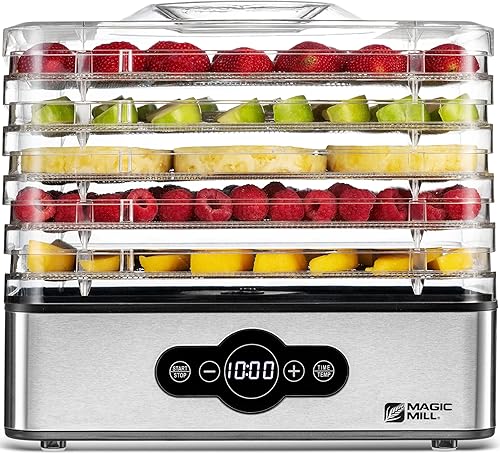
Magic Mill Premium Food Dehydrator Machine
9.6/10 our score
See it on Amazon -
3

- 4
 Check it
Magic Mill Food Dehydrator Machine
Best for adjustable tray height - 5
 Best for expanding a small batchCheck it
- 6
 Check it
Septree Food Dehydrators Machine with 12 Stainless
Best for a heavy harvest - 7
 Check it
Konfintos Small Food Dehydrator for Jerky
Best for small kitchens - 8
 Check it
Nutrichef Food Dehydrator Machine
Best for straightforward controls - 9
 Best for a low-footprint starterCheck it
Which fruit and vegetable dehydrators suit different batches?
The best choice depends on batch size and available space: the Cosori balances drying area and accessories, while Septree offers the most trays in this group. Compact models suit smaller batches and kitchens where counter space is tight.
We compared the stated features and fit for drying garden produce and seasonal fruit. Our score weighs specs, features and buyer feedback against what you're shopping for.
| Product | Best for | Tray count | Temperature range | Power | Our score |
|---|---|---|---|---|---|
| Commercial Chef Food Dehydrator | a compact, simple setup | 5 | 104–158 F | 280 W | 9.7 |
| Magic Mill Premium Food Dehydrator Machine | large, varied batches | 10 | 95–167 F | 700 W | 9.6 |
| Cosori Food Dehydrator | broad, even drying space | 6 | 95–165 F | 9.6 | |
| Magic Mill Food Dehydrator Machine | adjustable tray height | 5 | 95–167 F | 240 W | 9.5 |
| Cosori Food Dehydrator | expanding a small batch | 5, expandable to 7 | 95–165 F | 350 W | 9.5 |
| Septree Food Dehydrators Machine with 12 Stainless | a heavy harvest | 12 | 68–194 F | 1000 W | 9.4 |
| Konfintos Small Food Dehydrator for Jerky | small kitchens | 5 | 95–158 F | 250 W | 9.3 |
| Nutrichef Food Dehydrator Machine | straightforward controls | 5 | 600 W | 9.3 | |
| OSTBA Food Dehydrator | a low-footprint starter | 5 | 95–158 F | 240 W | 9.0 |
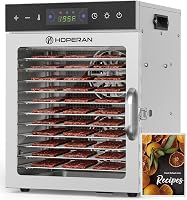
Commercial Chef Food Dehydrator: Best for a compact, simple setup
- 5 reversible BPA-free trays
- Temperature range of 104–158 F
- 280 W
- Compact 9.92 x 9.43 x 7.01 in body
Its small body and five reversible trays suit modest fruit and vegetable batches. The temperature control is mechanical.
Pros
- Small footprint
- Reversible trays allow more height for thicker foods
- Adjustable temperature
Cons
- Less drying space than cabinet-style models
- No digital timer stated
Commercial Chef suits a kitchen that needs a small, straightforward dehydrator for fruit, vegetables and herbs. Its five reversible 9.25 in trays give you two tray-height options, which can help when a batch includes thicker slices.
The temperature control is mechanical and ranges from 104 F to 158 F. The 9.92 x 9.43 x 7.01 in body is smaller than the cabinet-style models here, so it is easier to fit into a cupboard when you're done.
This is a practical fit for regular snacks or modest amounts of seasonal produce. It has less room than a 6-, 10- or 12-tray model, so larger harvests may take multiple rounds.
Magic Mill Premium Food Dehydrator Machine: Best for large, varied batches
- 10 extra-large stainless steel trays
- 700 W
- Temperature range of 95–167 F
- 48-hour digital timer
Ten trays and digital controls suit frequent drying across several kinds of produce. Its rear-mounted fan is designed to dry without manual tray rotation.
Pros
- Large tray count
- Digital timer and temperature control
- Dishwasher-safe trays
Cons
- Large 18 x 13 x 14 in body
- Heavier than compact models
Magic Mill's 10 extra-large stainless steel trays give you room to dry several layers of produce in one run. Its 48-hour digital timer and temperature controls from 95 F to 167 F allow you to set a longer drying cycle.
The rear-mounted fan and precision airflow are designed to dry across the trays without manual rotation. A transparent door lets you watch progress, and the trays are dishwasher-safe for cleanup.
This machine suits households that preserve fruit and vegetables often or process larger harvests. At 18 x 13 x 14 in and 20.5 lb, it needs a dedicated counter or storage spot.
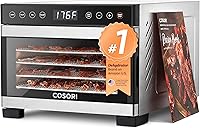
Cosori Food Dehydrator: Best for broad, even drying space
- 6 stainless steel trays
- 6.5 sq ft drying space
- Temperature range of 95–165 F
- 48-hour timer
This model pairs a sizable drying area with a rear-mounted fan and digital controls. It also includes a fruit roll sheet and mesh screen.
Pros
- 6.5 sq ft drying space
- Fruit roll sheet included
- Dishwasher-safe trays
Cons
- Takes more counter space than compact round models
- Six trays may be more than occasional users need
The Cosori's six stainless steel trays provide 6.5 sq ft of drying space, useful when you want to dry more produce at once. Its rear-mounted fan and airflow system are designed to dry evenly without manual tray rotation.
Digital controls set temperatures from 95 F to 165 F and a timer up to 48 hours. A fruit roll sheet and mesh screen are included, along with six dishwasher-safe trays.
Choose it for a mix of fruit slices, vegetables and fruit rolls, with enough space for a generous home batch. For fruit leather specifically, compare our guide to the best dehydrator for fruit leather.
Magic Mill Food Dehydrator Machine: Best for adjustable tray height
- 5 stackable stainless steel trays
- Temperature range of 95–167 F
- 48-hour digital timer
- Tray height adjusts from 0.6 to 1.1 in
Adjustable tray spacing gives you room for thicker fruit pieces or vegetables. Five trays and digital controls suit small to medium batches.
Pros
- Tray height adjusts for thicker foods
- Digital timer and temperature control
- Stainless steel trays
Cons
- Fewer trays than larger cabinet models
- Temperature range differs between product descriptions
Magic Mill's five stainless steel trays adjust from 0.6 to 1.1 in high. That spacing can make it easier to fit thicker pieces without giving up the smaller gap that suits thin slices.
Its digital controls allow a timer up to 48 hours and a stated temperature range of 95 F to 167 F. The compact 8.5 x 11.8 x 11 in body fits smaller kitchens better than a large cabinet dehydrator.
Pick this model if you want adjustable tray height and digital settings for small to medium batches. The listed temperature range differs between its product title and spec details, so check the current model information before choosing it for a particular recipe.
Cosori Food Dehydrator: Best for expanding a small batch
- 5 BPA-free trays
- Expandable to 7 trays
- Temperature range of 95–165 F
- Up to 48-hour timer
Start with five trays and add two more if your fruit and vegetable batches grow. Adjustable tray heights also help accommodate thicker pieces.
Pros
- Can expand to 7 trays
- Adjustable temperature in 1 F steps
- Quiet operation is rated below 47 dB
Cons
- Additional trays are separate accessories
- Round design uses vertical tray stacking
This Cosori comes with five BPA-free trays and can expand to seven with separate trays. Its adjustable height makes room for thicker produce, while the 95 F to 165 F temperature range offers more control than a basic fixed-temperature machine.
The round body measures 12.2 in across and 8.98 in high. A recipe book is included, and the stated operating noise is below 47 dB.
It is a flexible option if you want to begin with five trays and add capacity later. Remember that extra trays are separate accessories, and the stacked round design needs vertical clearance.
Septree Food Dehydrators Machine with 12 Stainless: Best for a heavy harvest
- 12 stainless steel trays
- 12.52 x 12.52 in tray size
- Temperature range of 68–194 F
- 1000 W
Its 12 trays and broad temperature range are suited to drying a large seasonal harvest. Septree describes horizontal hot-air circulation and two fans.
Pros
- High tray count
- Large individual trays
- Stainless steel trays are dishwasher-safe
Cons
- Requires more counter or storage space
- Timer runs up to 24 hours
The Septree provides 12 stainless steel trays, each measuring 12.52 x 12.52 in, for large batches of vegetables, mushrooms, herbs and fruit. Its 1000 W system uses two fans and horizontal hot-air circulation, according to the brand's product details.
The temperature range runs from 68 F to 194 F, with timer settings up to 24 hours. The trays are dishwasher-safe, and the unit includes a removable drip tray.
This is the strongest fit here for a heavy harvest or frequent batch drying. Its capacity comes with a larger machine, so measure your counter and storage space before settling on it.
Konfintos Small Food Dehydrator for Jerky: Best for small kitchens
- 5 height-adjustable BPA-free trays
- Temperature range of 95–158 F
- 250 W
- Up to 72-hour operation
A compact body and five trays suit small fruit and vegetable batches in kitchens with limited counter space. The clear trays let you check progress without opening the unit.
Pros
- Compact 7.28 x 11.81 x 7.87 in body
- Height-adjustable trays
- Dishwasher-safe trays
Cons
- Small-batch capacity
- Lower maximum temperature than some picks
The Konfintos is designed for small batches, with a compact 7.28 x 11.81 x 7.87 in body and five height-adjustable transparent trays. You can watch the produce through the trays without opening the dehydrator.
Its controls adjust from 95 F to 158 F, and it can operate for up to 72 hours. The 250 W system and small footprint make it a fit for apartments, dorms or kitchens where a full-size cabinet would take up too much space.
Choose it for a few trays of fruit or vegetables at a time. If your harvest regularly fills more than five trays, a larger dehydrator will reduce the number of batches.
Nutrichef Food Dehydrator Machine: Best for straightforward controls
- 5 stackable trays
- Temperature control up to 180 F
- 600 W
- One-touch operation
A single operational button makes this a simple option for household fruit and vegetable batches. Its five trays stack for storage.
Pros
- Simple one-touch operation
- Five stackable trays
- 600 W power
Cons
- No timer details stated
- Temperature control details are limited
NutriChef keeps operation simple with one button and five stackable trays. It has a 600 W system and temperature control up to 180 F, making it a straightforward choice for a household that wants to dry fruit and vegetables without a long list of settings.
The body measures 11 x 11 x 10.2 in, a manageable size for many counters. Details about timer settings and exact temperature steps aren't stated, so it may be less suited to recipes that call for precise controls.
Choose it if simple operation matters more than digital timing or a large tray count. Its five trays work best for regular home batches rather than a large harvest.
OSTBA Food Dehydrator: Best for a low-footprint starter
- 5 BPA-free trays
- Temperature range of 95–158 F
- 240 W
- 360-degree circulation airflow
Five trays, a small footprint and a simple temperature knob suit occasional home drying. The trays have two height settings for different food sizes.
Pros
- Compact design
- Two tray height settings
- Dishwasher-safe trays
Cons
- Less capacity than cabinet-style models
- Temperature range tops out at 158 F
OSTBA combines five BPA-free trays with a compact body and a simple temperature knob. The 95 F to 158 F range gives you adjustable heat for common fruit, vegetable and herb drying, while the stated 360-degree airflow circulates through the trays.
Each tray can be rotated to create two height settings. A transparent cover lets you check on food, and the trays are dishwasher-safe for easier cleanup.
This model suits a beginner or a household drying modest batches. Its 240 W power and five-tray capacity make it less suited to processing a whole garden harvest in one run.
How should you choose a dehydrator for fruit and vegetables?
Choose a dehydrator by the amount you dry at once, the space you have to store it, and how much control you want over time and temperature. Compare a dehydrator with a freeze dryer if you’re deciding between preservation methods.
Those factors matter more than a long feature list if your usual job is a small batch of apple slices or a full tray of garden produce.
How much tray space will your harvest need?
Five trays can be enough for snacks and small batches, while a larger harvest may call for six or more trays. Tray count is only a rough guide: compare the dimensions or stated drying area when available.
A stack of trays can save counter width but needs vertical space. Cabinet models take more room on a counter and often offer a larger working area.
Which controls help when drying fruit?
Temperature control lets you set the heat for the food you're drying, while a timer can help you plan long cycles. Digital controls show specific settings, and a mechanical knob is simple to operate but may offer less detail.
Follow a reliable recipe for the fruit or vegetable you're preparing. Don't assume one temperature or cycle length works for every food or slice thickness.
Do you need adjustable tray heights?
Adjustable spacing is helpful when some pieces are thicker than others or when you want more clearance between trays. Commercial Chef, Cosori and Magic Mill offer models with adjustable or reversible tray arrangements.
For fruit puree and thin mixtures, check whether a compatible fruit roll sheet is included. This fruit roll sheet guide explains what the accessory does.
How much counter space should you leave?
Measure the machine's footprint, height and storage spot before buying. Allow enough room to load trays and access controls, and check the manual for placement and ventilation instructions.
If you aren't sure how much capacity fits your routine, use our guide to what size food dehydrator you need. A vegetable slicer or mandoline slicer and chopper can also help you prepare more even slices.
Which fruit and vegetable dehydrator should you choose?
Choose the Cosori with six stainless steel trays if you want a broad drying area and an included fruit roll sheet. Pick Septree for a large harvest, Commercial Chef for a compact setup, or Konfintos for small batches in a tight kitchen.
After drying, use our guide to how to rehydrate dehydrated fruit when a recipe calls for a softer texture. If dried fruit is the main reason you're buying, compare the tray space and controls with the best food dehydrator for fruit.
Our top 3 picks at a glance
-
1
-
2
Best for large, varied batches
Magic Mill Premium Food Dehydrator Machine
9.6/10 our score
See it on Amazon -
3
Frequently asked questions
What makes a dehydrator good for fruit and vegetables?
A suitable dehydrator gives you enough tray space for your usual batch, adjustable temperature control, and airflow designed to dry food across the trays. For mixed produce, adjustable tray heights or a wide temperature range can help with different slice sizes and drying needs.
Also consider cleanup and where you'll store the machine.
How many trays do I need for a garden harvest?
The right tray count depends on how much produce you plan to dry at one time. Five trays can suit small household batches, while a 10- or 12-tray cabinet gives you more room for a large harvest.
Check the tray dimensions too, since tray count alone doesn't show the total drying area.
Can one dehydrator dry fruit and vegetables together?
Yes, if the foods can share the same temperature and drying schedule. Cut pieces to a similar thickness and check each tray as it dries, since different fruits and vegetables may finish at different times.
Keep strongly flavored foods separate if you don't want their aromas to mix.
Do I need a fruit roll sheet?
A fruit roll sheet helps hold pureed fruit in a thin layer while it dries. It can also be useful for small pieces that might fall through an open mesh tray.
Check whether a compatible sheet comes with the dehydrator or needs to be bought separately.
How should I prepare fruit before dehydrating it?
Wash and dry the fruit, remove pits or cores, and cut it into even pieces so they dry at a similar pace. Some fruits benefit from a pretreatment to reduce browning, but follow a reliable recipe for the specific fruit.
Let dried pieces cool before storing them in an airtight container.
How do I use dried fruit after storing it?
Dried fruit works as a snack or an ingredient in cereal, baking and trail mix. For recipes that need a softer texture, add water and allow time for the fruit to rehydrate.
Our guide explains how to use dehydrated fruit in everyday meals.