9 Best Cut Resistant Gloves for Chefs (November 2026)
The best cut resistant gloves for chefs include the NoCry Premium Cut Resistant Gloves Food Grade for everyday chef prep, the Schwer ProGuard High Level Cut Resistant Work for grip and high protection, and the NoCry Cut Resistant Work Gloves for Women for reinforced fingers.
On this page (4 sections)
The best cut resistant gloves for chefs are the NoCry Premium Food Grade Gloves because they combine food-safe construction, Level 5 protection, a snug fit and dexterity.
They suit chefs who slice, trim and guide food through a shift and want fabric gloves instead of metal mesh. The lightweight knit lets fingers bend to grip small items, season food and reach for handles.
This pick handles vegetables, meat and general prep without switching pairs. Choose a metal mesh glove for heavy blade work, or a lower-rated coated glove when flexibility and pack size matter more.
A coated glove can help with wet or slippery items, while metal mesh is aimed at more severe blade hazards. The right choice depends on your most common task and how much cover your guiding hand needs.
We compared products by food-handling suitability, stated cut protection, grip, dexterity, fit, cleaning and the number of gloves included. Each factor was weighed for daily chef use rather than general workshop use.
Food safety came first because direct food contact changes which gloves are suitable. Our score then weighs how the glove feels in use, plus care and pack quantity.
A glove that is hard to wash or comes as a single glove can cause problems in a busy kitchen. Multiple pairs make rotation easier, since you can wash one set while wearing a clean set.
A glove reduces risk but does not make careless cutting safe. You still need a firm grip on food, a stable board and a clear path for the blade.
Keep your guiding hand behind the blade and use a stable board. A damp towel under the board can stop it moving during slicing and trimming.
Keep fingertips curled back and wrists supported so the glove does not slide into the cutting line. Replace gloves when damaged, because a worn knit or bent metal ring no longer gives the same cover.
Check for loose threads, thinned areas and bent rings before each use. Retire a damaged glove rather than saving it for later, since cover may already be reduced.
If you also use a vegetable slicer, choose gloves that hold food securely without loose fabric near the blade. A close fit helps since excess material can snag or shift as you push food through a slicer.
Fabric gloves with medium stretch tend to follow the hand more closely than loose mesh. Pause and refit the glove if it turns or bunches during use.
For a Kevlar option, compare Kevlar cut resistant gloves. That comparison can help if you prefer a specific fibre type or a different feel on the hand.
Our guide to cut resistant gloves ansi explains how to compare protection levels. Read the level carefully, then check whether the glove is also described for food contact before kitchen use.
A high protection level does not always mean a glove is made for food preparation. Matching both points helps you choose a glove that fits the job and the surface it will touch.
Our picks at a glance
-
1
 Best for everyday chef prep
NoCry Premium Cut Resistant Gloves Food Grade
9.7/10 our score
See it on Amazon -
2
 Best for grip and high protection
Schwer ProGuard High Level Cut Resistant Work
9.5/10 our score
See it on Amazon -
3
 Best for reinforced fingers
NoCry Cut Resistant Work Gloves for Women
9.4/10 our score
See it on Amazon
- 4
 Check it
Dowellife ANSI A9 Cut Resistant Glove Food
Best for heavy-duty food processing - 5
 Check it
DULFINE A3/A4/A9 Cut Resistant 2/3/6/12 Pairs Work
Best for choosing a protection level - 6
 Check it
Dowellife Level 9 Cut Resistant Glove
Best for an X-Large chainmail fit - 7
 Check it
Schwer A9 Cut Resistant Metal Mesh Chainmail
Best for adjustable chainmail fit - 8
 Check it
Kebada C2 Cut Resistant Gloves
Best for light-duty kitchen work - 9
 Check it
Xuhal 20 Pairs Cut Resistant Gloves Level
Best for a large kitchen team
The best cut resistant gloves for chefs by kitchen task
The best overall choice is the NoCry Premium because it is food grade, ambidextrous, machine washable and supplied as 3 pairs.
The other picks are better for specific needs such as chainmail protection, reinforced fingers, grip or bulk purchasing.
Use this section to match the glove type to the task you do most often.
Fabric gloves favour dexterity and stretch, while metal mesh favours cover for severe blade hazards.
NoCry Premium Cut Resistant Gloves Food Grade: Best for everyday chef prep
- Food grade
- Level 5
- 3 pairs
- Ambidextrous
- Machine washable
Food-grade materials, a snug fit and ambidextrous design make these gloves a strong choice for daily kitchen cutting. They suit chefs who want flexible fabric gloves instead of metal mesh.
Pros
- Food grade
- 3 pairs
- Ambidextrous
- Machine washable
Cons
- Original grey color only
- No stated waterproofing
NoCry Premium is the strongest everyday pick for chefs who slice vegetables, use a mandoline or prepare meat.
The gloves use polyethylene, spandex and fiberglass, with a lightweight knit construction and regular fit.
They are food grade, ambidextrous and machine washable, so you can wear either glove on either hand and clean them between prep sessions.
The 3-pair package also gives you replacements when one pair is in the wash.
That rotation matters in a busy kitchen, since a damp glove is uncomfortable and harder to handle food with.
NoCry describes these gloves as EN388:2016 Level 5 and ANSI 105-2016 rated.
The snug fit and superior grip are aimed at keeping food secure while you work, but the gloves are not waterproof.
The medium stretch and lightweight fabric help fingers bend without the stiffness of coated or metal options.
Choose this pair for broad kitchen use and dexterity.
It is also a practical choice if you want fabric gloves rather than stainless steel mesh.
Schwer ProGuard High Level Cut Resistant Work: Best for grip and high protection
- ANSI A9
- Black sandy nitrile coating
- Reinforced thumb
- Touchscreen compatible
- 1 pair
This black ANSI A9 glove combines a sandy nitrile coating with a reinforced thumb. It fits chefs who want strong protection and grip for demanding cutting work.
Pros
- ANSI A9
- Non-slip coating
- Reinforced thumb
- Breathable 13-gauge knit
Cons
- One pair
- Not described as food grade
Schwer ProGuard suits chefs who want ANSI A9 protection with a black sandy nitrile coating.
For more coated options, compare nitrile coated cut resistant gloves.
The HPPE, polyester, spandex and metal wire construction is paired with a reinforced thumb and a 13-gauge knit.
That fine knit keeps the glove light and breathable while the yarn mix provides the cut resistance.
The coating is designed for abrasion resistance and grip in wet or greasy conditions.
That can help when you handle slippery food or tools, although the product is described as a work glove rather than specifically as food grade.
This is a one-pair option with a one-size-fits-all fit.
Touchscreen compatibility may help if you check a phone or tablet without removing the glove.
The pull-on closure keeps setup simple, with no clasp or strap to adjust.
Pick it when grip and high cut protection are your priorities.
Confirm food-contact suitability before using it for direct food preparation.
NoCry Cut Resistant Work Gloves for Women: Best for reinforced fingers
- Level 5
- Food grade
- 3-finger stainless steel reinforcement
- 5 sizes
- 3 pairs
Three vulnerable fingers have added stainless steel threads, while the rest uses lightweight stretch fabric. This is a useful fit for chefs who want extra finger protection without a full metal glove.
Pros
- Food grade
- 5 size choices
- Reinforced fingers
- Machine washable
Cons
- No stated waterproofing
- Requires careful size selection
NoCry Reinforced is designed for chefs who want extra protection on the fingers most exposed to cuts. Stainless steel threads reinforce 3 fingers, while polyethylene, glass fibre and spandex keep the rest of the glove lightweight and stretchy.
The gloves are food grade, Level 5 and available in 5 sizes. For a fit-focused comparison, see cut resistant gloves for women.
For a smaller fit, compare extra small cut resistant gloves.
That range makes careful measuring worthwhile, since a close fit supports knife control better than a loose glove. That range makes careful measuring worthwhile, since a close fit supports knife control better than a loose glove.
The 3-pair package works well for regular cooking. The gloves are machine washable, and NoCry describes them as breathable and suitable for cutting meat, vegetables, cheese and fish.
Choose this model if you like fabric gloves but want targeted reinforcement. It is less suitable if you prefer the full coverage feel of chainmail.
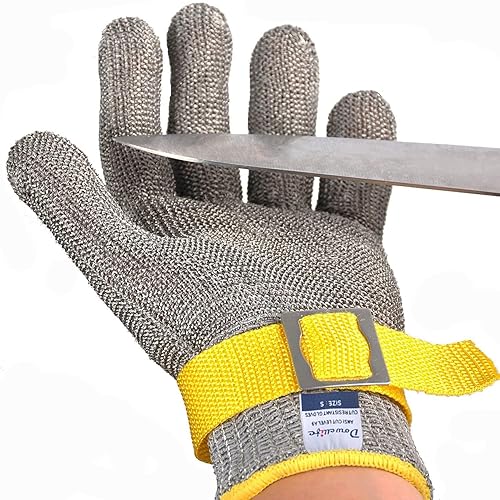
Dowellife ANSI A9 Cut Resistant Glove Food: Best for heavy-duty food processing
- ANSI A9
- 316 stainless steel wire
- HPPE yarn
- Machine washable
- White nylon inner glove
This ANSI A9 metal mesh glove is aimed at sharp-blade work such as butcher tasks, oyster shucking and food processing. It includes a soft nylon inner glove and an adjustable buckle.
Pros
- ANSI A9
- Food safe
- Adjustable buckle
- Touchscreen compatible
Cons
- Single glove
- No stretch
Dowellife ANSI A9 is the heavy-duty food-processing choice.
It uses 316 stainless steel wire and HPPE yarn, with an adjustable buckle and an included soft nylon inner glove.
The glove is food safe, ambidextrous and machine washable.
Dowellife describes it for butcher work, oyster shucking, meat processing, fish filleting and mandoline slicing.
The included inner glove can improve comfort and help the metal mesh sit more smoothly on the hand.
It is a single glove, not a pair, so buy according to the hand you need to protect or plan for the matching quantity.
The no-stretch metal construction favours protection over the flexible feel of knitted fabric.
The adjustable strap helps secure the fit at the wrist during repetitive cutting tasks.
Choose it for sharp-blade work where ANSI A9 protection matters.
For more detail on construction, read what are cut resistant gloves.
DULFINE A3/A4/A9 Cut Resistant 2/3/6/12 Pairs Work: Best for choosing a protection level
- A3, A4 and A9 options
- Foam nitrile coating
- Touchscreen compatible
- Machine washable
- Multiple pack options
DULFINE offers several protection and pack choices, with foam nitrile for grip in wet or greasy conditions. The A3 option is suited to medium cut hazards and lighter kitchen tasks.
Pros
- Multiple pack choices
- Foam nitrile grip
- Touchscreen compatible
- Machine washable
Cons
- Food-grade use is not stated
- Protection choice must be checked carefully
DULFINE gives you several protection and pack choices, including A3, A4 and A9 options and 2, 3, 6 or 12 pairs.
Its foam nitrile coating is intended to improve grip in wet or greasy conditions.
The A3 option is described for medium cut hazards, while the gloves also support touchscreen use and machine washing.
The A9 version in the range is aimed at higher-risk work, so the version you select changes the intended use.
Read the selected protection level carefully before ordering because the range includes different versions.
This is a useful choice for a shared kitchen or work area where pack size matters.
Multiple pairs let you replace a dirty or wet set without stopping prep for a wash cycle.
Food-grade use is not stated, so confirm that point before using the gloves for direct food contact.
Pick DULFINE when you want to match the protection level and number of pairs to your work.
It is less direct than a food-grade model with one fixed configuration.
Dowellife Level 9 Cut Resistant Glove: Best for an X-Large chainmail fit
- ANSI A9
- X-Large
- Pack of 2
- 316 stainless steel wire
- Machine washable
This X-Large Dowellife metal mesh option gives larger hands two gloves in the pack. It suits chefs who handle sharp blades and want food-safe stainless steel construction.
Pros
- ANSI A9
- X-Large size
- 2-count pack
- Food safe
Cons
- Metal mesh has no stretch
- No water resistance
Dowellife Level 9 is the best chainmail choice for larger hands because this version is X-Large and supplied as a pack of 2.
It uses stainless steel construction and is described as food safe.
The glove has an elastic and buckle closure, and it can be machine washed.
Dowellife also describes touchscreen operation, which may help when checking recipes or orders.
The pack of two can suit a kitchen that needs to protect both hands, or that wants a spare glove ready.
Like other metal mesh gloves, it has less stretch than a knitted fabric glove.
That trade-off means the fit must come from the size itself, not from stretch.
The X-Large size makes it important to compare your hand measurements before choosing it.
Choose this model when you need two high-protection gloves and a larger size.
For a mandoline-focused comparison, see best cut resistant gloves for mandoline.
Schwer A9 Cut Resistant Metal Mesh Chainmail: Best for adjustable chainmail fit
- 316L stainless steel
- Adjustable wrist clasp
- Reversible 5-finger design
- Food grade
- Medium
This medium chainmail glove uses an adjustable wrist clasp and fits either hand. Its stainless steel ring construction suits meat, fish, poultry, shucking and mandoline work.
Pros
- Food grade
- Adjustable clasp
- Fits either hand
- Easy to clean
Cons
- One glove
- Metal mesh has no stretch
Schwer Chainmail uses 316L stainless steel rings in a reversible 5-finger design.
The medium glove has an adjustable wrist clasp and is intended for meat, fish, poultry, oyster shucking and slicing.
The clasp helps you set the fit, while the stainless steel material is described as food grade and easy to clean.
Schwer recommends choosing the size carefully because metal ring gloves have no elasticity.
A thin inner glove can make a looser mesh feel more comfortable, as noted in the product guidance.
The package includes 1 glove, an elastic band and a user manual.
It is a single glove, so it suits kitchens that protect one guiding hand during cutting.
Daily cleaning is recommended for food processing use, since residue can build up between the rings.
Choose it for adjustable chainmail protection.
If you prefer a flexible coated glove, this will feel less forgiving than the fabric options.
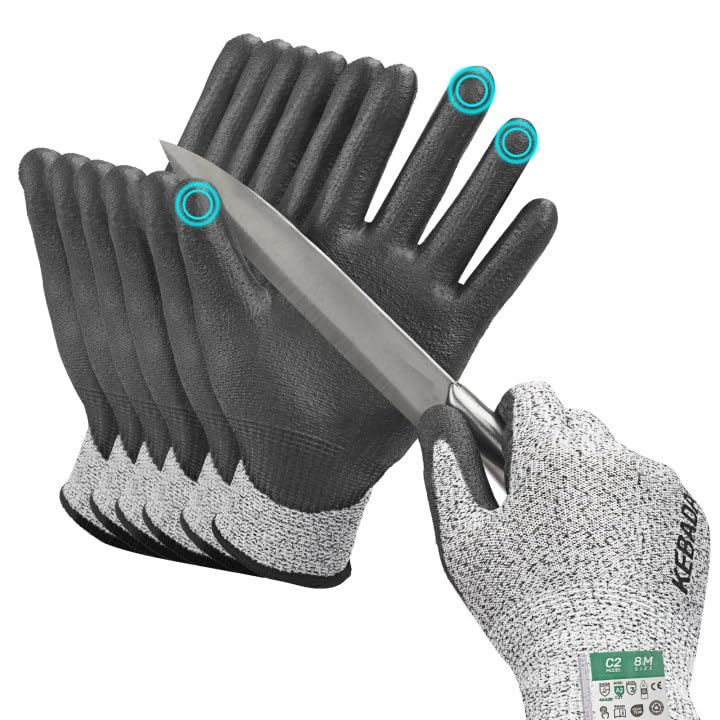
Kebada C2 Cut Resistant Gloves: Best for light-duty kitchen work
- ANSI A2
- PU coating
- Touchscreen compatible
- 3 pairs
- Machine washable
Kebada uses lightweight smooth knit construction, a PU coating and an elastic cuff for general light-duty cutting. It fits chefs who value flexibility and a three-pair pack.
Pros
- 3 pairs
- Lightweight
- PU grip
- Machine washable
Cons
- ANSI A2
- Food-grade status is not stated
Kebada C2 is the light-duty choice for chefs who want 3 pairs, a PU coating and a flexible smooth knit.
The gloves use fiberglass, HPPE and spandex, with a 24 cm length and an elastic cuff.
They qualify as ANSI A2 and are described for general light-duty anti-cut use.
The PU coating supports grip, while touchscreen compatibility and machine washing add convenience.
The smooth knit and medium stretch help the glove move with the hand during chopping and peeling.
The material is latex free, and the ambidextrous design lets either glove fit either hand.
Food-grade status is not stated, so check that point before using them for direct food contact.
Choose Kebada for vegetable prep and lighter cutting tasks where flexibility and a multi-pair pack matter more than the highest protection level.
Our guide to how do cut resistant gloves work explains why material and rating affect protection.
Xuhal 20 Pairs Cut Resistant Gloves Level: Best for a large kitchen team
- 20 pairs
- Level 5
- 4 sizes
- Ambidextrous
- Machine washable
Xuhal is the bulk choice for kitchens that need many pairs for daily prep, training or shared workstations. Four sizes and a stretchy nylon blend make fitting easier.
Pros
- 20 pairs
- 4 size choices
- Level 5
- Food safe for kitchen cutting
Cons
- Large pack may be excessive for home cooks
- No stated waterproofing
Xuhal is the bulk option, with 20 pairs of Level 5 gloves in a stretchy nylon and spandex blend.
Four sizes, from S through XL, make it easier to outfit a kitchen team or keep spare pairs available.
The gloves are described as food safe for kitchen cutting, ambidextrous, flexible and machine washable.
Their non-slip design is intended to help when handling food, peelers and slicers.
The smooth knit and medium stretch help each pair sit close without a stiff feel.
A 20-pair pack is more than most home cooks need, but it can make sense for shared prep stations, classes or frequent washing.
Bulk packs also reduce disruption when one pair is drying or needs replacing.
Measure carefully because the pack does not remove the need for a proper fit.
Choose Xuhal when quantity and Level 5 protection are the main goals.
For a grip-focused alternative, compare best cut resistant gloves with grip.
How to choose cut resistant gloves for chef work
Choose food-grade construction first when the glove will touch food. This matters for slicing meat, vegetables, cheese and fish, where the glove may rub against food throughout prep.
NoCry Premium, NoCry Reinforced, Dowellife and Schwer Chainmail are the clearest food-focused choices in this group. Those options are described with food grade or food safe materials for kitchen use.
If a glove is described mainly for work use, confirm food-contact suitability before using it for prep. A glove made for construction or general handling may not be intended for direct food contact.
Check the material and care notes before putting it on for kitchen tasks. Next, match the protection level to the task.
ANSI A9 metal mesh options suit severe blade hazards, while Level 5 fabric gloves offer a balance of protection and movement for regular prep. Level 5 fabric is often easier to wear for long periods because it stretches and feels closer to a normal glove.
ANSI A2 and A3 options suit lighter or medium cut hazards. Those lower levels can suit vegetable prep, peeling and general handling where the risk is lower.
A higher level is not a reason to use unsafe technique. Sharp blades, poor hand position and a moving board can still cause harm.
Use the protection level as support for safe habits, not as a replacement for them. Fit affects control.
Fabric gloves stretch more easily, while chainmail has no stretch and may need an adjustable clasp or careful sizing. A stretch fabric can adapt to small differences in hand size, but it still needs to sit close at the fingers.
Chainmail relies on the size itself, so measuring matters more. A glove should stay close to your hand without making it hard to bend your fingers.
Too loose, and fabric can shift near the blade. Too tight, and fatigue can set in during long prep sessions.
Numb fingers or constant pressure can reduce control just as much as poor grip. Grip also matters when food is wet or oily.
Sandy nitrile, foam nitrile and PU coatings can help you hold objects, but confirm food-contact suitability when the product is primarily described for work use. A grippy palm may steady a handle or a slippery item during prep.
Coating also changes how the glove feels for fine work. An uncoated knit may feel thinner and more flexible, which can help when turning small pieces or working near a slicer.
Think about care as well. Machine washable pairs fit a daily routine, while metal mesh needs attention to rings and clasps.
Fabric gloves can usually go in the wash more easily, while mesh needs checking after cleaning. Check what is included, since some options are single gloves and others are multi-pair packs.
That detail affects cost per usable glove and how easily you can rotate a clean pair. A single glove may suit one guiding hand, while a multi-pair pack suits regular use and washing.
How to clean and use chef cut gloves
Follow the cleaning method given for your chosen glove.
Different materials need different care, so check the notes for fabric, coating and metal parts before washing.
Several fabric and metal mesh options here are machine washable, while the Dowellife metal mesh descriptions also mention hand washing or dishwasher cleaning.
Use the method that matches your glove rather than treating every pair the same way.
For fabric gloves, a cool wash with mild detergent and air drying helps protect the knit and stretch.
Hot water and strong detergents can weaken fibres and reduce the feel of the glove over time.
Air drying also helps the glove keep its shape for the next use.
For metal mesh, clean daily in food processing use and make sure no residue remains between the rings.
Food particles can sit between small rings and make rinsing less effective.
A thorough clean after each shift helps keep the mesh hygienic and ready for the next task.
Let gloves dry fully before storing them.
Damp gloves can feel uncomfortable and may be harder to put on for the next prep session.
Full drying also makes it easier to spot damage before you wear them again.
Hang metal gloves by their loop where provided, and keep clasps and buckles clean and free from food matter.
A clean clasp is easier to adjust and less likely to stick during use.
Store fabric gloves flat or folded once they are dry.
Check the knit, coating, fingers, clasp and metal rings each time you use them.
Look for snags, worn coating, loose threads or bent rings that could reduce cover.
Pay attention to fingertips and thumb areas, since those parts take more wear during prep.
Look for snags, worn coating, loose threads or bent rings that could reduce cover.
Small changes can affect how the glove sits on the hand and how much cover it gives.
Replace a damaged glove instead of relying on it for protection.
A worn area should not be trusted for demanding blade work.
Retiring a damaged pair also prevents flakes, threads or broken parts from reaching food.
Store clean, dry gloves away from sharp tools so storage does not damage them.
A drawer or clean container keeps the shape intact and stops hooks or blades catching the knit.
Keep metal gloves separate from tools that could bend the rings.
Use a glove as one part of safe knife technique.
Keep blades sharp, cut away from your protected hand and use a stable cutting surface.
A sharp blade needs less force and is easier to guide through food.
Keep the guiding hand behind the blade and pause if the glove feels loose or wet.
Refit or replace the glove before continuing, rather than working with poor control.
Wet fabric can slip, and loose mesh can shift at the wrist during cutting.
Which cut resistant gloves for chefs should you buy?
Pick NoCry Premium for the best balance of food safety, Level 5 protection, dexterity and 3-pair value.
That mix suits chefs who need a daily fabric glove for slicing, trimming and general prep.
The snug fit and lightweight knit help it feel flexible during long periods of kitchen work.
Choose Dowellife ANSI A9 or Schwer Chainmail for heavy blade work.
Those metal mesh options are aimed at butcher tasks, oyster shucking, meat processing and other sharp-blade jobs.
Their stainless steel construction gives a different feel from fabric and needs more attention to fit.
Pick NoCry Reinforced for added finger protection without a full metal glove.
Three fingers have extra stainless steel threads, while the rest stays lightweight and stretchy.
That design can suit chefs who want targeted cover on the fingers most exposed during cutting.
Choose Xuhal for a large kitchen team that needs many pairs across several sizes.
The 20-pair pack makes sense for shared stations, training and frequent washing.
Smaller kitchens may not need that quantity, so match the pack to your actual use.
For lighter prep, Kebada offers a flexible ANSI A2 option with 3 pairs.
Its PU coating and smooth knit suit vegetable prep and general handling where flexibility matters.
The lower protection level means it is better matched to lighter tasks than severe blade hazards.
If grip is your main concern, compare the coated Schwer and DULFINE choices.
Sandy nitrile and foam nitrile coatings can help with wet or greasy items.
Then confirm food-contact suitability before using them in the kitchen.
A work-focused coating still needs checking for direct food preparation.
Match the fit to your hand before you commit.
Fabric gloves stretch, while chainmail relies on size, clasp or buckle adjustment.
Measure your hand and follow the size guidance for the model you choose.
That check should stop a loose or overly tight glove from changing how you hold food and tools.
A close fit supports control and makes the glove easier to wear through a full prep session.
Our top 3 picks at a glance
-
1
Best for everyday chef prep
NoCry Premium Cut Resistant Gloves Food Grade
9.7/10 our score
See it on Amazon -
2
Best for grip and high protection
Schwer ProGuard High Level Cut Resistant Work
9.5/10 our score
See it on Amazon -
3
Best for reinforced fingers
NoCry Cut Resistant Work Gloves for Women
9.4/10 our score
See it on Amazon
Frequently asked questions
What are the best cut resistant gloves for chefs?
The NoCry Premium Food Grade Gloves are the best cut resistant gloves for chefs who want food-safe materials, Level 5 protection, dexterity and 3 pairs. Choose an ANSI A9 metal mesh glove for heavier blade work, or a lower-rated coated glove for lighter prep.
Are cut resistant gloves safe for food preparation?
Choose a glove that is specifically described as food grade or food safe. NoCry Premium, NoCry Reinforced, Dowellife ANSI A9, Dowellife Level 9, Schwer Chainmail and Xuhal are described for food handling.
Wash and dry gloves as directed before reuse.
Should chefs choose fabric or metal mesh gloves?
Fabric gloves usually offer more stretch and dexterity, while metal mesh gloves focus on higher protection for demanding blade work. Fabric picks here include NoCry and Kebada.
Dowellife and Schwer offer stainless steel mesh options with less stretch.
What does ANSI A9 mean for kitchen gloves?
ANSI A9 is a high cut resistance level used for gloves intended for severe cut hazards. It does not replace safe knife handling, a stable cutting board or proper hand position.
Check that the glove is also suited to food contact before kitchen use.
How should chefs choose the right glove size?
Measure your hand and follow the product's size guidance. NoCry Reinforced offers 5 sizes, Xuhal offers S through XL, Schwer Chainmail is adjustable in medium, and Dowellife Level 9 is X-Large.
A close fit supports dexterity without restricting movement.