6 Best Rotary Mandoline Slicers (November 2026)
The best mandoline rotary slicers include the Geedel Rotary Cheese Grater Vegetable Shredder for most kitchens, the Geedel Rotary Cheese Grater for simple everyday shredding, and the Ourokhome Rotary Cheese Grater Hand Crank for gifting and beginners.
On this page (6 sections)
- Best mandoline rotary slicer picks, compared by blade and design
- How do these rotary slicers compare side by side?
- How do we choose a mandoline rotary slicer for repetitive prep?
- How do you set up and use a rotary mandoline safely?
- What is the difference between a rotary slicer and a container mandoline?
- Which rotary mandoline slicer should you buy?
The best mandoline rotary slicer for most kitchens is the Geedel Rotary Cheese Grater Vegetable Shredder with 6 interchangeable blades, because it covers slicing, shredding, wavy cutting and crushing without changing tools.
The best mandoline rotary slicer for you depends on blade count, counter space and how much cheese or vegetable prep you do each week.
A rotary drum slicer works differently from a flat mandoline.
You lock a suction base to the counter, feed food through a transparent barrel with a pusher, and turn a crank.
The drum does the cutting, so your hands stay away from the blade and each turn gives a repeatable cut.
That contained design is why rotary models suit cheese and bulk vegetables better than a flat plate in many kitchens.
We compared specs, blade sets, sizes and included parts across these six models.
Our score weighs specs, features and buyer feedback against what you are shopping for.
No prices, star ratings or review counts appear here, so you can judge the tools on function alone.
If you want a broader starting point, our vegetable slicer buying guide explains drum, flat and chopper styles.
For a closer look at set kinds, see mandoline slicer and chopper combos.
And if space is tight, check the best small mandoline slicer picks before you choose a larger drum.
Our picks at a glance
-
1
 Best for most kitchens
Geedel Rotary Cheese Grater Vegetable Shredder
9.7/10 our score
See it on Amazon -
2

-
3
 Best for gifting and beginners
Ourokhome Rotary Cheese Grater Hand Crank
9.5/10 our score
See it on Amazon
- 4
 Check it
Airpro Rotary Cheese Grater with Handle
Best for a compact round design - 5
 Check it
BNUNWISH Rotary Cheese Grater Shredder 5-in-1 Tumbling
Best for julienne cuts - 6
 Check it
BNUNWISH Rotary Cheese Grater Shredder with Handle
Best for easy hand cranking
Best mandoline rotary slicer picks, compared by blade and design
Six blades give the top pick the widest range, while the 3-blade models keep prep simple and storage easier.
The BNUNWISH 5-in-1 stands out for julienne cuts, and the two BNUNWISH and Airpro options suit buyers who want a plain, compact drum.
Blade shape matters as much as blade count in daily use.
Fine shredding suits cheese and chocolate, coarse shredding suits potatoes and carrots, and slicing suits cucumbers and zucchini for salads.
Geedel Rotary Cheese Grater Vegetable Shredder: Best for most kitchens
- 6 interchangeable stainless steel blades
- No-slip suction base
- Transparent barrel
- Food pusher and detachable handle
Six blades cover more textures than the 3-blade sets, and the suction base keeps the drum steady during repetitive prep.
Pros
- 6 blades for slicing, shredding, wavy cutting and crushing
- Suction base locks to countertops
- Food pusher keeps hands away from blades
Cons
- More blades to store and clean
- Larger barrel than simpler 3-blade models
This Geedel suits cooks who prep vegetables, cheese and toppings in bulk and want one tool to cover many textures.
Its 6 interchangeable blades add extra-fine shredding, wavy slicing and crushing to the usual slicing and shredding set, so lunchbox carrots, taco toppings and delicate cheese shreds can come from the same base.
Extra-fine shredding is useful for cheese that needs to melt evenly, while wavy slicing changes presentation for cucumbers and potatoes.
The Z-shaped handle needs only gentle rotation, and the suction base locks to countertops for steady work.
The transparent barrel lets you watch food feed through, while the pusher guides ingredients and keeps fingers at a distance from the stainless steel blades.
At 4 x 8 x 9 inches and 1.5 pounds, it is a mid-size counter tool that stores in a cupboard.
Parts detach for rinsing, and top-rack dishwasher washing is recommended.
The ABS handle contains no BPA, which matters when the tool contacts food directly.
The trade-off is more blades to store and wash than a 3-blade set, but for repetitive prep that range is the point.
Geedel Rotary Cheese Grater: Best for simple everyday shredding
- 3 interchangeable stainless steel blades
- Suction base
- Transparent barrel
- Food pusher
A lighter 3-blade Geedel that does the core jobs well, with slicing, shredding and grinding in a compact frame.
Pros
- Lightweight at 12.8 ounces
- 3 blades for core tasks
- Detachable parts for rinsing
Cons
- Fewer textures than the 6-blade Geedel
- No wavy or crushing blade
This Geedel suits buyers who want the core rotary jobs without extra blades to manage.
Its 3 stainless steel blades cover slicing, shredding and grinding for cheese, peanuts, almonds, cookies and vegetables, which handles most daily tasks from salads to hash browns.
The shredding blade suits middle hard and hard cheese, potatoes and carrots, while the fine shredding blade suits chocolate, nuts and biscuits for desserts.
At 12.8 ounces, it is the lightest pick here, so it is easy to lift, store and clean.
The suction base holds firm on clean, smooth counters like marble or glass, and the inclined transparent barrel helps food exit without jamming.
Food-grade ABS with no BPA is used for the body, and all parts detach for a quick rinse or top-rack dishwasher washing.
The rectangular and round shape fits varied storage spaces more easily than a long cylindrical model.
The trade-off against the 6-blade Geedel is range: no wavy slicing, extra-fine shredding or crushing.
If those cuts matter, step up.
If not, this simpler set is easier to live with.
Ourokhome Rotary Cheese Grater Hand Crank: Best for gifting and beginners
- 3 drum blades
- Suction base
- Peeler and cleaning brush included
- Food pusher
Three blades plus a peeler and brush make it an easy first rotary slicer, aimed at cheese, vegetables, nuts and chocolate.
Pros
- Peeler and cleaning brush included
- 3 blades for slicing and shredding
- No electricity needed
Cons
- Heavier than the 3-blade Geedel
- Only 3 blades
This Ourokhome suits beginners and gift buyers who want a complete starter kit.
It comes with 3 drum blades plus a peeler and a cleaning brush, so you can prep potatoes and carrots and clean the drum without buying extras on day one.
The peeler helps with carrots and potatoes before they reach the drum, and the brush helps clear shredded cheese from the blade teeth.
The white, cylindrical body runs without electricity, which makes it a good choice for a second kitchen, a dorm or anyone who dislikes cords on the counter.
Slicing, coarse shredding and fine shredding cover cheese, potato, carrot, cucumber, radish, nuts, chocolate and broccoli.
At 10.24 x 2.76 x 9.45 inches and 0.92 kg, it is longer and heavier than the light Geedel, so measure your cupboard before you buy.
The suction base locks to the counter, and the food pusher keeps hands away from the blade.
The drum also handles ice and other firm foods, though it is not suitable for meat and chicken.
The trade-off is a plain 3-blade range, but the included tools and simple crank make it an easy first rotary slicer.
Airpro Rotary Cheese Grater with Handle: Best for a compact round design
- 3 stainless steel blades
- Strong suction base
- Round mandoline design
- Food pusher
A compact round drum with 3 blades and a suction base for cheese, vegetables and fruit in small kitchens.
Pros
- Compact round shape
- 3 blades for slicing and grating
- Suction base for smooth counters
Cons
- Only 3 blades
- Fewer included accessories than some rivals
This Airpro suits small kitchens that need a compact, round drum.
Its 3 interchangeable blades handle slicing, shredding and coarse grating for cheddar, mozzarella, parmesan, carrots, potatoes, cucumbers and fruit, with a food pusher for safety.
Medium hardness cheeses including cheddar, mozzarella, parmesan, Romano and mascarpone work well, as do nuts, crackers and chocolate.
The body mixes stainless steel and plastic in a modern, round shape, and the suction base grips marble and glass counters firmly.
The tilted curvature lets grated food fall out smoothly, which reduces clogging during longer sessions.
Parts come apart for cleaning, and the stainless steel body can be stored in a drawer or cupboard.
Airpro provides a user guide for first-time users and after-sales support.
BPA-free materials and rust-free stainless steel blades support safe food contact.
The trade-off is a basic 3-blade set with fewer accessories than the Ourokhome or BNUNWISH picks.
Choose it if a clean, compact drum matters more than extra blades.
BNUNWISH Rotary Cheese Grater Shredder 5-in-1 Tumbling: Best for julienne cuts
- 5 blades including 2mm and 4mm julienne
- Storage box
- Larger hopper
- Suction base
Two julienne sizes set this 5-blade tumbling box apart, with a bigger hopper for larger pieces.
Pros
- 5 blades with julienne options
- Storage box included
- Larger hopper for bigger food
Cons
- Heaviest pick at 2.3 pounds
- Taller footprint
This BNUNWISH suits cooks who want julienne cuts along with slicing and shredding.
Its 5 blades include a 2mm slicing blade, 2 x 2mm and 4 x 4mm julienne blades, a shredding blade and a weave blade, so you can cut matchsticks for stir-fries without a separate knife technique.
The 2mm julienne suits finer garnishes, while the 4mm julienne suits thicker vegetable strips for salads and cooked dishes.
The tumbling box design comes with a special storage box, which helps keep blades together in a drawer.
A larger hopper makes it easier to add bigger pieces of potato or carrot, and the wider suction base helps it stick to marble counters.
At 9 x 4.7 x 10.6 inches and 2.3 pounds, it is the tallest and heaviest pick here, so bench and cupboard space need checking.
Blades are 402J2 stainless steel and other parts are food-grade, BPA-free ABS.
Turning the handle once is described as equal to twelve regular cuts, which helps with larger batches.
The trade-off is size, but for julienne variety this is the most blade-rich option below the 6-blade Geedel.
BNUNWISH Rotary Cheese Grater Shredder with Handle: Best for easy hand cranking
- 3 replaceable stainless steel drum blades
- Upgrade strong suction
- Brush, lid and peeler included
- BPA-free ABS body
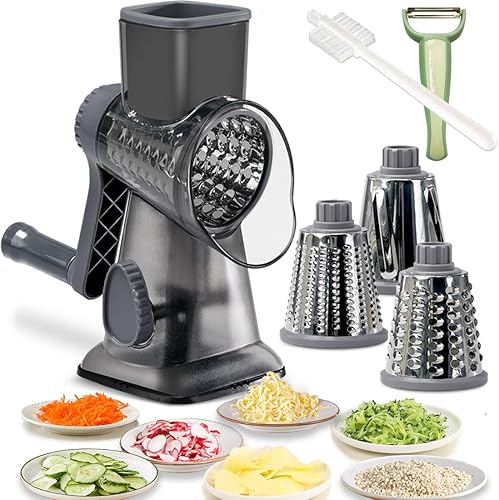
A dark grey 3-blade rotary slicer with a strong suction base and included brush and peeler for simple daily use.
Pros
- Strong suction base
- Brush and peeler included
- 3 blades for fine, coarse and slicing
Cons
- Only 3 blades
- Hand wash recommended below 140F
This BNUNWISH suits buyers who want a straightforward hand-crank slicer with a strong base.
Its 3 replaceable 402J2 stainless steel drum blades cover fine grating, coarse grating and shredding, and slicing, which suits cheese, carrots and vegetables for everyday meals.
One crank turn is described as equal to 12 ordinary cuts, which helps with larger batches.
The drum sits at an angle so food falls out smoothly, and the upgraded suction base holds the unit firm on a clean, smooth countertop.
That diagonal placement reduces clogging compared with a flat drum position, especially with shredded cheese.
At 8.7 x 4.5 x 9.25 inches and 0.75 kg, it is compact enough for most cupboards.
A brush, lid and peeler are included, and the body is BPA-free ABS plastic.
The one-piece body design makes installation simpler, with the handle and drum placed directly on the body.
Hand washing below 140F is recommended, which is a small extra step versus dishwasher options.
Choose it for simple, steady cranking without extra blade shapes.
How do these rotary slicers compare side by side?
Blade count is the clearest divider in this group.
Two models offer 6 or 5 blades, and the rest offer 3.
Size and weight also vary, from the light 12.8-ounce Geedel to the 2.3-pound BNUNWISH tumbling box.
| Product | Best for | Blades | Size | Weight | Our score |
|---|---|---|---|---|---|
| Geedel Rotary Cheese Grater Vegetable Shredder | most kitchens | 6 | 4"L x 8"W x 9"H | 1.5 pounds | 9.7 |
| Geedel Rotary Cheese Grater | simple everyday shredding | 3 | 4.72"L x 4.92"W x 9.37"H | 12.8 ounces | 9.6 |
| Ourokhome Rotary Cheese Grater Hand Crank | gifting and beginners | 3 | 10.24"L x 2.76"W x 9.45"H | 0.92 kg | 9.5 |
| Airpro Rotary Cheese Grater with Handle | a compact round design | 3 | 9.2 | ||
| BNUNWISH Rotary Cheese Grater Shredder 5-in-1 Tumbling | julienne cuts | 5 | 9"L x 4.7"W x 10.6"H | 2.3 pounds | 9.0 |
| BNUNWISH Rotary Cheese Grater Shredder with Handle | easy hand cranking | 3 | 8.7"L x 4.5"W x 9.25"H | 0.75 kg | 8.7 |
We compared blade count, blade shapes, suction base design, body size, weight, included tools and cleaning method.
We checked the specs for each model and looked at how the drum shape affects feeding and storage.
We did not test any tool directly, so claims about speed and ease come from the brands and from buyer patterns.
How suction, barrel shape and included tools differ
Suction bases appear on every pick here.
That matters for safety and steadiness, because a drum slicer needs a fixed countertop to work well.
A clean, smooth surface gives the best grip, and the pusher keeps food moving without fingers near the blade.
Barrel shape also affects daily use in practical ways.
An inclined or tilted barrel helps shredded food drop out instead of building up inside the drum.
A transparent barrel lets you see when food is fed correctly and when the drum needs a pause.
Included tools vary more than many buyers expect at first.
The Ourokhome and the dark grey BNUNWISH include a peeler and brush, which helps with prep and cleaning from the start.
The BNUNWISH 5-in-1 includes a storage box for its blades, which helps keep a larger set organized.
Two trade-offs run through the group.
More blades mean more cuts but more parts to store and wash.
Bigger hoppers and wider bases help with large batches but take more cupboard space.
Your counter size and storage should guide the choice as much as blade count.
How do we choose a mandoline rotary slicer for repetitive prep?
Start with the foods you prep most often.
Cheese, potatoes, carrots and cucumbers are the core jobs for every pick here.
If you also want wavy slices, crushing or extra-fine shredding, the 6-blade Geedel covers those cuts.
If julienne matters, the BNUNWISH 5-in-1 has two julienne sizes.
Think about batch size as well as food type.
A larger hopper helps when you shred several potatoes for hash browns or a large block of cheese for a family meal.
A smaller drum still works for those jobs, but you will feed food in smaller pieces and refill more often.
How many blades do you really need?
Three blades cover slicing, coarse shredding and fine shredding, which is enough for most salads, hash browns and cheese topping.
Five or six blades add shapes that help with presentation and texture.
More blades suit cooks who vary recipes through the week, while a 3-blade set suits repetition of the same few tasks.
Consider ice, nuts and chocolate too, because some drums handle those firm foods well.
If you crush ice or grind nuts often, check that the blade set includes a suitable drum for that texture.
What size fits your kitchen?
Measure the counter area where the base will sit and the cupboard where it will store.
The longest model here is over 10 inches, and the tallest is over 10 inches high.
A compact drum suits a small kitchen, while a larger hopper suits bulk vegetable prep.
Weight affects storage as well as counter use.
The 12.8-ounce Geedel is easy to move and store, while the 2.3-pound BNUNWISH stays put but takes more effort to lift.
How important is a suction base?
A suction base is important for any rotary slicer you will use on a smooth counter.
It keeps the drum from sliding while you crank with one hand and push with the other.
Check that your counter is clean and smooth before each session, and re-lock the base if it releases.
Some counters have texture or seams that weaken suction, so test the base before you load food.
If the base will not hold, the tool will be harder to use safely and evenly.
How do you set up and use a rotary mandoline safely?
Lock the base first, then fit the barrel, drum and handle in order.
Feed food with the pusher and turn the crank at a steady pace.
Small pieces feed more evenly than large chunks, and the tilted barrel on these models helps food exit without jamming.
Start with how to use a mandoline vegetable slicer if you are new to drum tools.
The same pusher and crank habits apply, and the same rule holds: keep fingers behind the pusher and away from the blade edge.
Setup order also prevents wobble during the first turns.
Snap the barrel into the base, seat the drum correctly, then attach the handle before you add food.
If parts feel loose, stop and reseat them rather than forcing the crank.
Which foods should you avoid in a drum slicer?
Very soft, juicy or slippery foods can slip or jam.
Meat is a common question, and our guide on mandoline slicer for meat explains why drum and flat slicers are not built for that job.
Stick to firm vegetables, hard and semi-hard cheeses, nuts and chocolate for best results.
Soft cheeses and very ripe fruit can smear inside the barrel and make cleaning harder.
Test a small piece first when you try a new food, and watch how it exits the drum.
How should you clean and store the blades?
Remove the drum and handle after each use, rinse parts under running water, and dry blades well.
Top-rack dishwasher washing is listed for some models, while hand washing below 140F is recommended for the dark grey BNUNWISH.
Store blades where edges will not knock against other tools.
Drying matters for stainless steel as well as for the ABS body and suction base.
Water left on a drum can spot the surface and make the next use less smooth.
A brush helps remove cheese residue from fine teeth without putting fingers near the edge.
What is the difference between a rotary slicer and a container mandoline?
A rotary slicer cuts cheese and vegetables through a drum, while a container mandoline cuts on a flat plate and collects slices below.
Container models suit thin, even vegetable slices for gratins and salads.
Drum models suit shredding, grating and bulk prep, and they contain the blade inside the barrel.
If you mainly slice vegetables into a container, compare with our best mandoline slicers with containers guide.
That style keeps slices in one place as you work, which helps for layered dishes.
A rotary drum is better when you need shreds, not flat slices.
The two tools also differ in hand position during use.
A flat mandoline needs downward pressure on a plate, while a rotary drum needs cranking plus pusher pressure.
That difference affects steadiness, especially on counters where a flat plate may slide.
Which style suits cheese best?
A rotary drum is the better tool for cheese.
Flat mandolines are not built for grating hard cheese, and cheese can clog a flat plate.
Drum blades on these models are shaped for cheese, nuts and chocolate, with fine and coarse options.
Fine shredding melts well on pizza and toast, while coarse shredding suits salads and hash browns.
Which style suits thin vegetable slices best?
A flat mandoline or container mandoline gives thinner, more uniform slices than most drum blades.
Drum slicing blades still work for cucumbers, potatoes and carrots, but slice thickness is fixed by the drum.
Choose a flat tool if thin slices are your main goal.
Which rotary mandoline slicer should you buy?
The best mandoline rotary slicer for most kitchens is the Geedel with 6 blades, because its extra cuts cover more recipes without extra tools.
The best mandoline rotary slicer for a small kitchen is the compact Airpro or the light 3-blade Geedel, depending on whether you want a round drum or the lightest weight.
Pick the Geedel 6-blade if you prep cheese and vegetables often and want wavy, extra-fine and crushing options.
Pick the Geedel 3-blade if you want the same steady base with fewer parts.
Pick the Ourokhome if you want a peeler and brush in the box.
Pick the BNUNWISH 5-in-1 if julienne cuts are a priority, and the dark grey BNUNWISH if you want a plain 3-blade crank with a strong suction base.
Before you order, measure your counter and cupboard, and check the blade set against the foods you cook most.
Also check your counter material, because suction works best on clean glass, marble and other smooth surfaces.
A rotary slicer earns its space when it takes over repetitive prep you do every week, not when it adds blade shapes you rarely use.
Our top 3 picks at a glance
-
1
Best for most kitchens
Geedel Rotary Cheese Grater Vegetable Shredder
9.7/10 our score
See it on Amazon -
2
-
3
Best for gifting and beginners
Ourokhome Rotary Cheese Grater Hand Crank
9.5/10 our score
See it on Amazon
Frequently asked questions
What is a rotary mandoline slicer?
A rotary mandoline slicer uses a hand crank to turn a drum blade against food fed through a barrel. You push food with a pusher and turn the handle to slice or shred.
It gives steady repetitive cuts without a flat mandoline sliding on the counter.
Can a rotary slicer replace a flat mandoline?
It replaces a flat mandoline for shredding and grating, and it handles slicing in a more contained way. A flat mandoline still gives thinner, more even slices for some dishes.
Many cooks keep both, but a rotary drum is better for cheese and bulk vegetables.
What foods work best in a rotary drum slicer?
Hard and semi-hard cheeses, potatoes, carrots, cucumbers, zucchini, nuts and chocolate work well. Soft, juicy or very soft foods can jam or turn to mush.
Test a small piece first to see how it feeds through your chosen blade.
How do I keep a rotary slicer steady?
Lock the suction base on a clean, smooth countertop and press firmly before you start. Add food through the pusher in small pieces and turn the handle at a steady pace.
If the base slips, clean and dry the counter and base, then re-lock it.
How do I clean drum blades safely?
Remove the drum and handle, then rinse parts under running water. Use the included brush where provided, and keep fingers away from blade edges.
Dry blades well before storage to help stainless steel stay clean.