Meat Slicer and Grinder Combo Setup Guide
A separate meat slicer and grinder is usually the most flexible setup, while a compact slicer plus grinder works better when counter space and budget matter. Choose based on the cuts you need, batch size, cleanup and whether you want manual or electric prep.
On this page (10 sections)
- What should you choose for a meat slicer and grinder combo?
- Is a slicer attachment enough for meat preparation?
- What makes a good slicer for a combo setup?
- Which setup is best for beef jerky?
- Which setup is best for lunch meat?
- How should you compare motor power and blade size?
- How do you keep a slicer and grinder combo clean?
- How much counter space does each slicer need?
- Should you buy a combo or separate meat tools?
- Final choice for a meat slicer and grinder combo
A separate meat slicer and grinder is the best all-around setup for most home kitchens because each tool does one job well. Choose a slicer plus grinder combo only when saving storage space matters more than having dedicated controls and easier replacement.
A slicer turns boneless meat into thin portions for sandwiches, stir-fry, hot pot and jerky. A grinder breaks meat into smaller pieces for burgers, sausage-style recipes and meatloaf.
Those jobs need different cutting actions, so a machine that combines them may involve trade-offs in capacity, cleanup or control.
The right choice depends on how often you prepare meat, how thin the slices need to be, how much counter space you have and whether you prefer powered or manual work.
What should you choose for a meat slicer and grinder combo?
Choose a combined machine for occasional, space-limited prep, and choose separate tools for regular batches or more precise work. A combo can reduce the number of appliances, but a dedicated slicer gives you a clearer setup for consistent portions.
Start by writing down the tasks you actually perform:
- Thin slices for lunch meat, sandwiches or cooked roasts
- Thin, even pieces for beef jerky
- Shaved meat for hot pot or stir-fry
- Ground meat for burgers, meatloaf or fillings
- Small batches prepared by hand
- Larger batches where motor power saves time
If slicing is your main task, buy the slicer first. A grinder attachment does not replace a proper slicing blade, and a slicer does not automatically grind meat.
If grinding is the main task, a dedicated grinder may be the better first purchase. Add a slicer later when you need thin, uniform cuts.
For broader food preparation, our vegetable slicer guide explains how slicers differ by food type, cutting action and cleanup needs.
Is a slicer attachment enough for meat preparation?
A slicer attachment can help when you already own a compatible appliance, but compatibility must be confirmed before you plan around it. Check the exact appliance model, attachment name and intended food use rather than assuming that accessories fit across a brand's product range.
A compatible attachment may reduce storage needs. It can also mean that one motor, housing or control system handles several jobs, which may be useful in a small kitchen.
The trade-off is that an attachment can take longer to install and clean than a dedicated tool. You may also need to stop and change parts between slicing and grinding.
Look for these details before choosing an attachment-based setup:
- Which appliance accepts the attachment
- Whether the attachment is made for meat
- How the food is held during slicing
- Which parts must be removed for cleaning
- Whether the appliance supports the batch size you expect
- Whether replacement blades or parts are available
A combo setup makes the most sense when you already own the base machine and use both functions often enough to justify the extra part. If you are buying from scratch, compare the total storage, cleaning and replacement needs against two simple tools.
What makes a good slicer for a combo setup?
A good slicer should match your food size, desired thickness and prep volume. Thickness control, safe food holding and removable food-contact parts matter more than a long feature list.
Electric slicers can reduce manual effort during repeated cuts. Manual slicers can take less space and give you direct control, but they depend more on correct food preparation and steady movement.
For a detailed decision process, use this meat slicer guide when comparing blade size, thickness range, controls and cleaning.
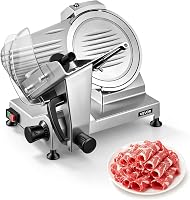
VEVOR Commercial Meat Slicer
The VEVOR Commercial Meat Slicer suits shoppers who want an electric slicer for larger or more demanding home preparation. It has a 10 in carbon steel blade, a 240W motor, a 350 to 400 rpm operating speed and a thickness range from 0 to 0.47 in, or 0 to 12 mm.
The product weighs 34 lb and measures 18 in L x 14 in W x 15 in H, so it needs a stable storage and operating location. Its semi-automatic operation reduces repeated hand motion compared with a fully manual slicer.
The food-contact parts use food-grade materials, and the stainless steel tray, blade, food holder and food pusher are removable for cleaning. The food pusher has raised spikes, while non-slip feet help keep the slicer stable during use.
The built-in sharpening stone is designed to keep the blade sharp. The blade is described for frozen, raw and cooked meats, as well as ham, so it can cover several slicing routines when used according to the instructions.
Choose this model when powered slicing speed and a 10 in blade matter more than a light countertop footprint. Its size and weight make it less suitable for a kitchen where the slicer must be moved after every use.
Borlebbi Meat Slicer
The Borlebbi Meat Slicer fits buyers who want an electric slicer with a smaller body and two removable blades. It uses a 200W motor, two 7.5 in stainless steel blades and thickness adjustment from about 0 to 15 mm.
It measures 14.17 in L x 12.2 in W x 9.64 in H and weighs 10.7 lb, making it easier to move and store than the VEVOR. Its die-cast aluminum body is described as durable, rust resistant and easy to clean.
The slicer is designed for meat, bread, cheese and vegetables. Its removable blade, food carriage, slide-rod extension and food pusher support cleaning after use, while the stainless steel tray catches sliced food.
Non-slip suction cup feet help hold the machine in place. The food pusher also acts as a blade guard, and the on/off switch adds a separate control point during operation.
Choose it when compact electric slicing is more important than a larger blade. It is a practical match for a home combo setup where the grinder is a separate tool and the slicer needs to fit in a cabinet or on a normal countertop.
Manual Frozen Meat Slicer befen Upgraded Home
The Manual Frozen Meat Slicer befen Upgraded Home suits buyers who want a manual tool for thin frozen-meat slices. It uses a stainless steel body, an 8 in high-carbon stainless steel blade and an adjustable thickness range from 0.2 to 20 mm.
It measures 18.11 in L x 6.3 in W x 4.72 in H and weighs 5.8 lb. The package includes the slicer, a separate meat holder, 2 blades with 1 installed, 10 plastic meat bags, 2 backup suction cups, an Allen wrench and an instruction manual.
This slicer is intended for properly frozen meat. The product information recommends thin slices because they are easier to cut cleanly, and it warns against slicing bone or fully thawed meat.
The manual design avoids a motor, which can simplify the tool's footprint and control. The trade-off is that your hand supplies the slicing force, so it is better suited to smaller batches than repeated high-volume prep.
Choose it when thin frozen slices and compact storage matter most. Pair it with a separate grinder if you also prepare burgers, meatloaf or other ground-meat recipes.
Which setup is best for beef jerky?
For beef jerky, choose a slicer that can make thin, even pieces, then use a separate grinder only if you also make ground-meat jerky. Slice thickness affects drying time, texture and how evenly the meat cooks or dries.
The VEVOR offers a 0 to 12 mm range and a 10 in blade for powered slicing. The Borlebbi offers a 0 to 15 mm range with two 7.5 in blades.
The befen offers a 0.2 to 20 mm range, but it requires properly frozen meat and manual effort.
The broad thickness ranges do not mean every setting suits jerky. Start with the thickness recommended by your recipe and keep the pieces as even as possible.
For more product-focused comparisons, see our guide to meat slicers for beef jerky. It is also useful to read how to use a meat slicer machine before working with a new blade and food carriage.
Which setup is best for lunch meat?
For lunch meat, an electric slicer is usually the easier choice because it reduces hand effort during repeated portions. The VEVOR fits larger slicing sessions, while the Borlebbi fits a smaller kitchen and lighter routine.
A manual slicer can still work when you prepare small batches and prefer direct control. The befen's narrow 6.3 in width may help with storage, but it requires properly frozen meat and manual movement.
Your target thickness matters as much as motor power. A slicer with a clear adjustment knob lets you repeat a setting across several portions, while a manual tool may take more practice to keep every slice alike.
Compare more options in our meat slicers for lunch meat guide.
How should you compare motor power and blade size?
Compare motor power and blade size against your batch size, not as isolated numbers. A larger blade can cover more food surface, while motor power can reduce effort during repeated electric slicing.
The VEVOR has the largest blade here at 10 in and a 240W motor. It also weighs 34 lb, which signals a heavier setup to position and store.
The Borlebbi has a 200W motor and two 7.5 in blades. Its 10.7 lb weight and smaller dimensions make it easier to move than the VEVOR.
The befen is manual, with an 8 in blade and a 5.8 lb weight. It has no motor, so the main trade-off is lower powered convenience in exchange for a compact manual format.
Use blade size as a guide to the food dimensions you plan to slice. Do not assume a larger blade automatically makes a machine better for every kitchen.
How do you keep a slicer and grinder combo clean?
Clean the slicer after every use by removing the food-contact parts and washing them by hand according to the care instructions. Keep the blade, food holder, pusher and tray free of leftover meat before storing the tool.
The VEVOR, Borlebbi and befen products specify hand washing. Do not assume their parts are dishwasher safe.
For a safe cleaning routine:
- Turn off and unplug an electric slicer before removing parts.
- Remove the food holder, pusher, carriage or blade parts that the instructions identify.
- Wash food-contact pieces by hand.
- Clean around joints and fasteners without soaking parts that should stay dry.
- Dry every part fully before reassembly.
- Store blades where they cannot contact hands or loose kitchen tools.
Use the same approach for a grinder attachment or separate grinder. Meat residue can remain inside small openings, so disassemble only as far as the instructions allow and clean each food-contact part.
A cut-resistant glove may help during cleaning, but it does not make a moving or exposed blade safe. Our guide to cut-resistant gloves for meat slicer cleaning covers that specific task.
How much counter space does each slicer need?
The Borlebbi needs the least listed counter space among the electric models, while the befen is the narrowest overall. Measure both the stored footprint and the working area needed to load meat, hold a tray and clean the parts.
| Product | Operation | Listed dimensions | Weight | Thickness range |
|---|---|---|---|---|
| VEVOR Commercial Meat Slicer | Semi-automatic electric | 18 x 14 x 15 in | 34 lb | 0 to 12 mm |
| Borlebbi Meat Slicer | Automatic electric | 14.17 x 12.2 x 9.64 in | 10.7 lb | 0 to 15 mm |
| befen Upgraded Home | Manual | 18.11 x 6.3 x 4.72 in | 5.8 lb | 0.2 to 20 mm |
The listed dimensions do not include extra room for a plate, tray or your hands. Leave enough space to move food safely and remove parts for washing.
If you need an electric slicer but have limited storage, compare the compact options in our best small meat slicers guide. If you need a larger commercial-style machine, see our best commercial meat slicer guide.
Should you buy a combo or separate meat tools?
Buy a slicer plus grinder combo when you need both functions but have limited storage and modest prep batches. Buy separate tools when slicing consistency, grinding capacity, cleanup access or replacement flexibility matters more.
Use this decision rule:
- Choose the VEVOR when you want powered slicing, a 10 in blade and a heavier commercial-style machine.
- Choose the Borlebbi when you want electric slicing, two removable blades and a smaller countertop footprint.
- Choose the befen when you want manual thin slicing of properly frozen meat and a narrow tool.
- Choose a separate grinder when ground meat is a regular part of your cooking.
- Choose an attachment only after confirming that it fits your exact appliance.
A combo can be efficient, but it should not force you to compromise on the task you do most. If you make jerky and lunch meat every week, prioritize the slicer.
If burgers and ground-meat recipes lead your routine, prioritize the grinder and add slicing later.
Final choice for a meat slicer and grinder combo
The best meat slicer and grinder combo setup depends on which task drives your kitchen. Pick the VEVOR for powered slicing and a larger 10 in blade, the Borlebbi for compact electric slicing, or the befen for manual frozen-meat prep.
For the broadest long-term use, pair the slicer that fits your space and batch size with a separate grinder that matches your ground-meat routine. That setup costs you another storage spot, but it keeps slicing and grinding decisions clear.
Before buying, measure the storage area, confirm the thickness range you need, and plan how each food-contact part will be cleaned by hand.
Frequently asked questions
Is a meat slicer and grinder combo better than separate tools?
A meat slicer and grinder combo can save space, but separate tools usually give you more control over slicing and grinding tasks. Choose a combined setup when storage is limited and your batches are modest.
Choose separate tools when you prepare large amounts, need dedicated controls or want to replace one tool without changing the other.
Can one machine slice and grind meat?
Some appliances are designed to slice and grind, while others only perform one task or accept a separate attachment. Check the exact model before ordering.
A slicer uses a blade to make thin portions, while a grinder needs a grinding mechanism, so do not assume that a meat slicer can process ground meat.
What is the best setup for beef jerky?
A meat slicer is usually the more important tool for beef jerky because even slices dry at a more predictable rate. A manual frozen meat slicer can suit thin batches, while an electric slicer can reduce effort for larger prep sessions.
Use a separate grinder only when you also make ground-meat recipes.
Should meat be frozen before slicing?
Partially frozen meat is easier to slice evenly than fully thawed meat because it holds its shape. The befen manual slicer recommends properly freezing the meat and notes that thinner slices are easier to cut cleanly.
Never try to slice bone, and follow the tool's instructions for preparation.